
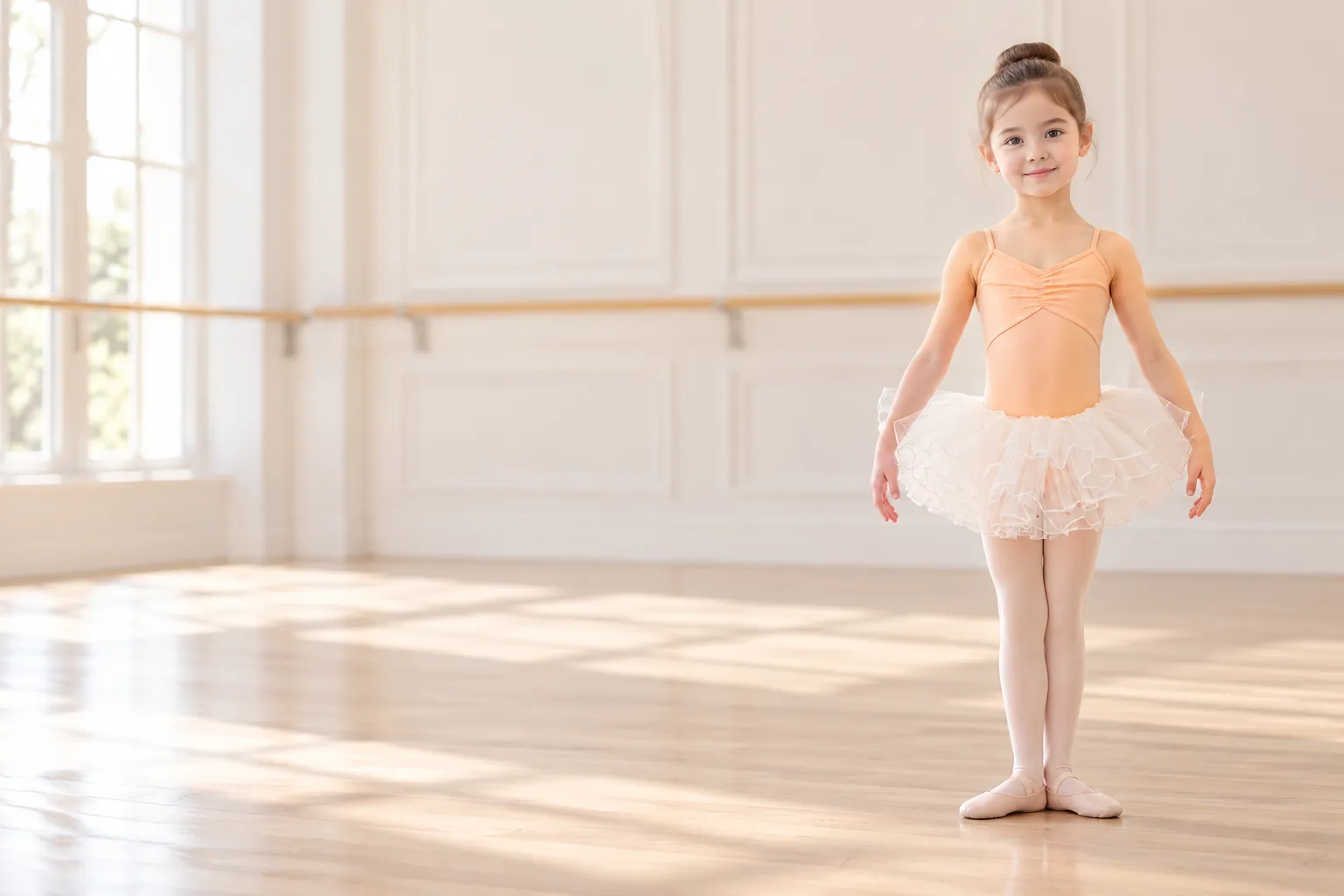
Short answer: a leotard is a fitted, one-piece garment that covers the torso and leaves the legs bare. Dancers wear it because it moves with the body, stays in place and lets the teacher see posture and alignment. It is the base of the ballet uniform.
What does a leotard look like?
A leotard looks like a swimsuit without leg coverage. It has straps or sleeves, a neckline and a closed seat, and it is made of a stretchy fabric that follows the body. Most ballet leotards have a smooth, plain front. Some have extra details such as pinched fronts, lace panels or crossed straps.
Why do dancers wear leotards?
- Freedom to move. Stretchy fabric does not restrict the arms, back or hips.
- A clear line. The teacher can see the position of the torso and shoulders.
- Safety. Nothing loose can catch on hands or feet.
- A neat look. A class in matching leotards looks focused and tidy.
Leotard, bodysuit or unitard?
| Leotard | Bodysuit | Unitard | |
|---|---|---|---|
| Legs | Bare | Bare | Covered, to the knee or ankle |
| Fasteners | None, pulls on | Often snaps at the base | None, pulls on |
| Used for | Ballet class and exams | Fashion and layering | Contemporary, gymnastics |
The words overlap, and many shops use “bodysuit” for a dance leotard. In ballet class, a leotard is the expected garment.
What is it made of?
Most ballet leotards use a stretch blend, such as cotton with spandex, or nylon with spandex. Cotton blends are soft and breathable. Nylon blends are smooth and dry fast. Check the label for stretch, because a leotard without it will restrict movement.
How do I choose one?
- Check your school’s uniform list for color and style.
- Choose the size by height and torso length. See our size guide.
- Try it on at home, then check that the straps lie flat and the legs do not pinch.
- Wash it on a cool cycle and air dry.
Common spelling mistakes
You may see “leatard” or “liatard” in searches. The correct spelling is leotard, named after Jules Léotard, a French acrobat. The word is pronounced “lee-uh-tard”.
A short history
The leotard is named after Jules Léotard, a French acrobat of the nineteenth century who performed on the trapeze in a close-fitting garment that let him move freely. The idea of a fitted, one-piece garment later spread to dance and gymnastics, where freedom of movement and a clear body line matter. Today the leotard is the base layer in ballet, and it is worn by dancers of all ages.
Who wears leotards?
- Ballet dancers of all ages, from toddlers to professionals.
- Gymnasts, who wear a similar garment, often with sleeves and more decoration.
- Acrobats and circus performers, for ease of movement.
- Fitness students, in some studio classes.
What should I look for in a first leotard?
- Soft fabric with stretch.
- Straps that lie flat and do not itch.
- A neckline that stays in place when the dancer bends.
- A color that matches the school’s uniform list.
How is a leotard cared for?
Wash it after each use in cool water on a gentle cycle. Do not use bleach or fabric softener, which can wear out the elastic. Let it air dry away from direct heat. A well-cared-for leotard can last a year or more, depending on how fast the dancer grows.
Frequently asked questions
What is a leotard?
A leotard is a fitted, one-piece garment that covers the torso and leaves the legs bare. Dancers wear it for freedom of movement and so the teacher can see their posture.
Why do ballet dancers wear leotards?
They move with the body, stay in place, and let the teacher see alignment and posture.
What is the difference between a leotard and a bodysuit?
A leotard is a pull-on garment for dance. A bodysuit often has snaps at the base and is used in fashion, but the terms overlap.
What is a unitard?
A unitard is like a leotard but with legs, which may reach the knee or ankle.
How do you spell leotard?
L-e-o-t-a-r-d. Common misspellings include leatard and liatard.