
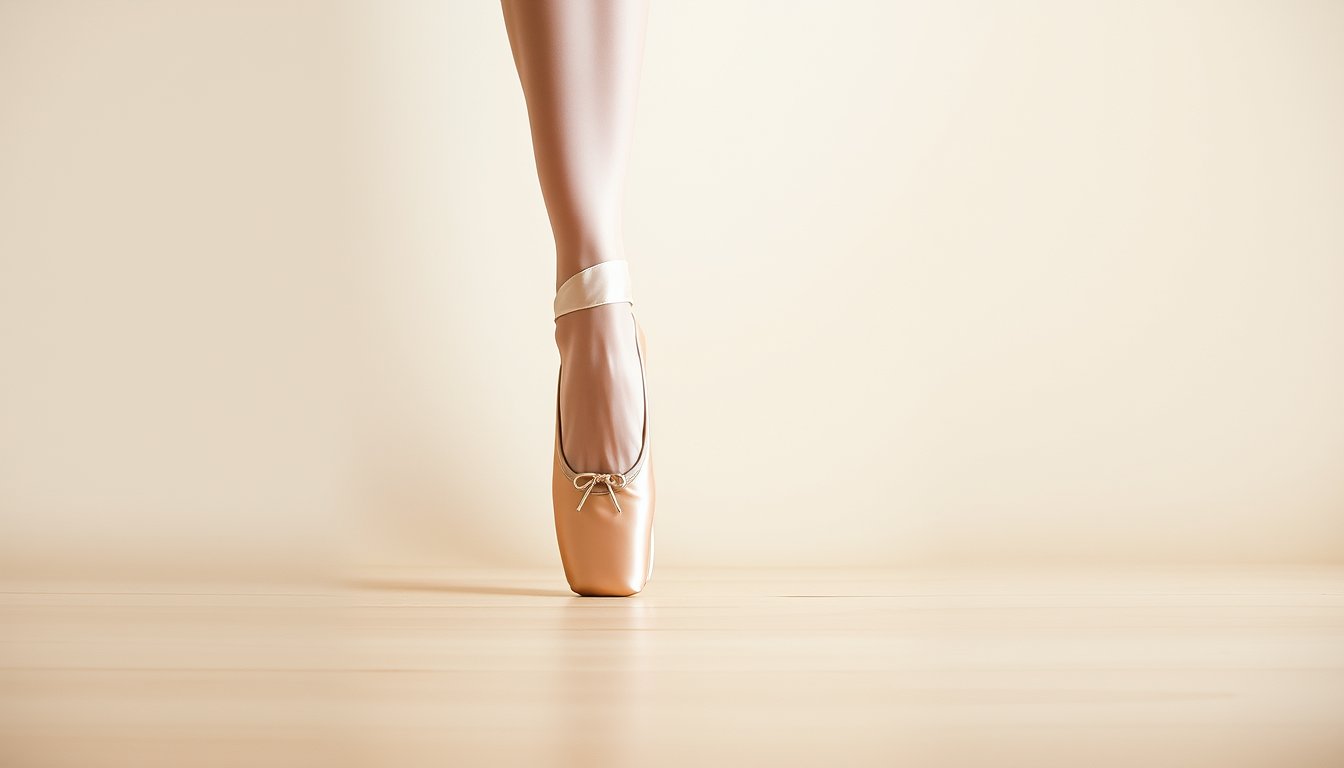
Ballet positions of the body describe the arrangement of the arms, head, torso and feet relative to each other and to the audience. Understanding these positions helps students follow corrections and remember combinations more precisely. The terminology is French, as it comes from the 17th-century French codification of ballet technique.
Positions of the Feet
There are five standard positions of the feet in classical ballet, numbered 1 through 5. All of these positions involve turned-out feet — the heels and toes rotate outward, with the rotation coming from the hip joint.
- First position: heels together, toes pointing outward to form a straight line
- Second position: feet apart (approximately hip-width), toes pointing outward
- Third position: one foot in front of the other, heel of the front foot touching the middle of the back foot (less commonly used in contemporary syllabuses)
- Fourth position: one foot in front of the other, feet separated by about 30 cm / 12 inches
- Fifth position: one foot directly in front of the other, toe of the front foot touching the heel of the back foot
Positions of the Arms (Port de Bras)
Port de bras refers to the carriage of the arms. Different schools (RAD, Cecchetti, Vaganova) use slightly different arm position numbering, but the underlying shapes are similar. In the RAD system:
- Bras bas (preparatory position): arms low, curved gently in front of the body, palms facing inward
- First position: arms curved in front of the body at waist/navel height
- Second position: arms extended to the sides at shoulder height, elbows slightly bent
- Third position: one arm overhead, one in second
- Fourth position: one arm overhead, one in first
- Fifth position (en haut / high fifth): both arms overhead, curved
Épaulement
Épaulement (from the French for “shouldering”) refers to the slight rotation and inclination of the shoulders and head in relation to the front direction. A dancer standing en face is facing directly front, both shoulders square. A dancer showing épaulement has turned slightly so one shoulder is forward and the head inclines toward or away from it.
Épaulement gives classical ballet its characteristic three-dimensional quality and prevents the art form from looking flat or mechanical. It is introduced gradually in graded classes — students in the lower grades focus primarily on placement and basic technique, while épaulement becomes more refined through Grades 5-8 and Vocational level.
Positions of the Body (En Face, Croisé, Effacé, etc.)
When the body is angled to a corner of the room rather than facing directly front, specific French terms describe the resulting position:
- En face: facing directly front, shoulders square
- Croisé (crossed): the body is angled to a corner, and the working leg crosses the line of the body relative to the audience — creating a visually dynamic, dynamic angle
- Effacé (shaded): the body is angled to a corner, but the working leg opens away from the audience — a more open, expansive look
- Écarté (separated): the body is angled to a corner, with the working leg extended directly to the side toward the upstage corner
- À la quatrième (to the fourth): the leg extends to the front or back, directly facing the audience
Why Does This Terminology Matter?
Ballet teachers use this terminology constantly during class. When a teacher says “croisé devant” they mean the leg extends to the front in the croisé angle — a student who does not know what croisé means will take longer to respond to corrections. Learning the terminology alongside the technique helps students progress faster and prepares them for examinations where instructions are given using these terms.
For more background on what students learn at each grade level, see our ballet grades guide.