
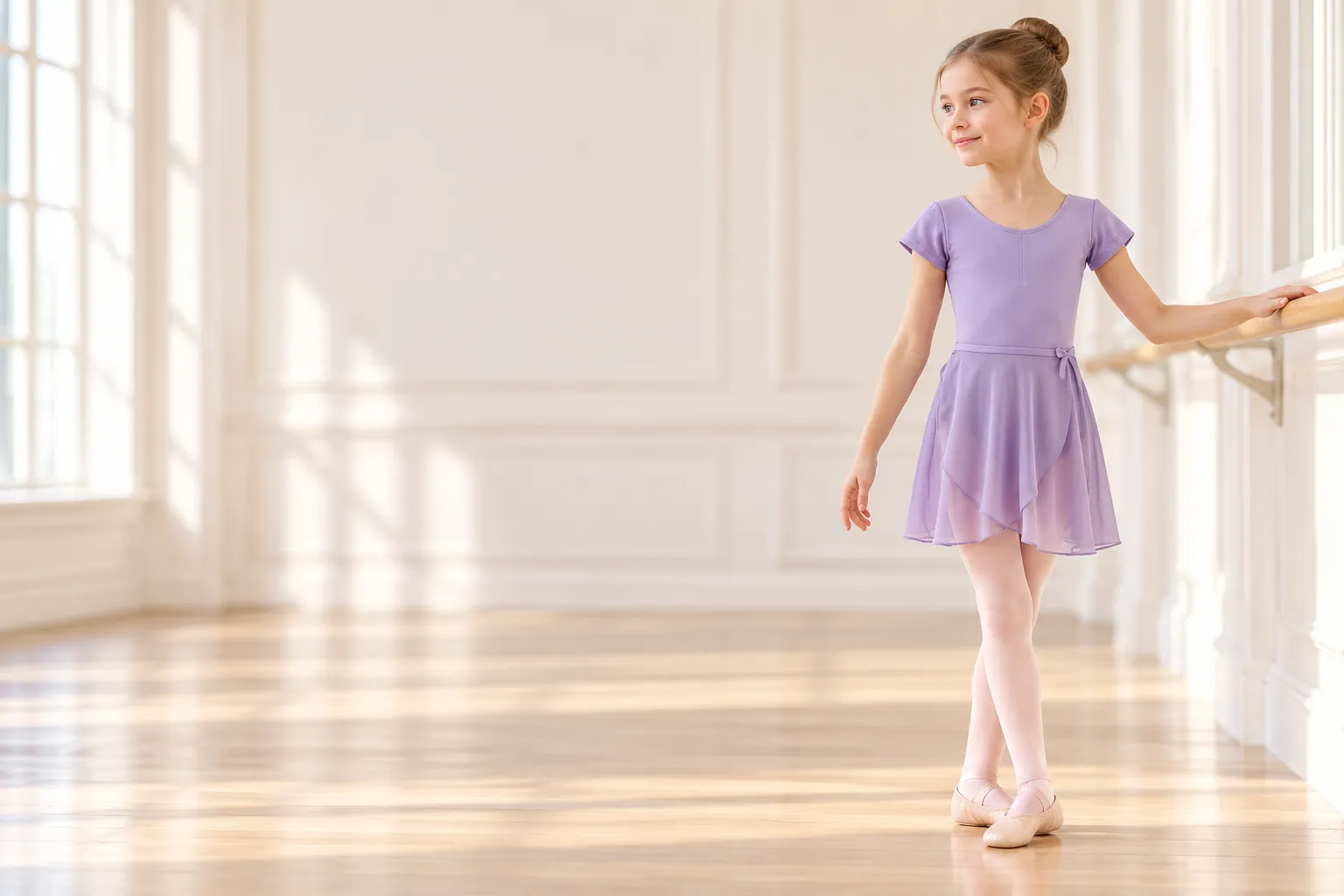
Short answer: wrap the skirt around the waist with the tie ends at the front, cross the ends, pull them around to the back, and tie a flat bow or double knot at the side. Keep the knot on the hip, not the back, so it does not press into the spine when lying down.
See also: Browse our range of ballet skirts and wrap skirts.
What is a ballet wrap skirt?
A ballet wrap skirt is a light skirt, usually in chiffon or georgette, that wraps around the waist and fastens with ties instead of an elastic band. It is easy to put on and take off, and it adjusts to different waist sizes. Many schools allow one over a leotard for class or exams.
How do I tie it?
- Hold the skirt open and place the middle of the waistband at the back, with the two tie ends hanging at the front.
- Bring one side across to the front so the skirt overlaps, then hold it in place with your hand.
- Cross the ties at the front, take them around the back, then bring them to the side.
- Tie a small, flat bow or a double knot on the hip and tuck the ends under the waistband.
How do I keep it neat and in place?
- Put it on over the leotard and tights, with the waistband at the natural waist.
- Smooth the overlap so no gap shows.
- Choose a skirt size that overlaps by a few inches, not one that only just closes.
- Use a double knot for young dancers so it does not undo during class.
Common problems
| Problem | Quick fix |
|---|---|
| The skirt gapes | Wrap more tightly or choose a larger size. |
| The bow comes undone | Use a double knot and tuck the ends. |
| The ties feel bulky | Move the knot to the side and flatten it. |
| The skirt rides up | Fasten at the natural waist, not the hip. |
When is a wrap skirt used?
Some schools use a wrap skirt at the Foundation and graded levels, in a color set by the school. Check whether it is required or optional before buying, and always keep the leotard and tights as the main uniform underneath.
Why choose a wrap skirt over a pull-on skirt?
A wrap skirt fits a range of waist sizes, so it lasts longer for a growing dancer. It also adjusts easily if the dancer wears a slightly thicker leotard or has just eaten. A pull-on skirt, by contrast, has a fixed waist and can be quicker to put on for very young children. Many schools allow either, so choose the one the dancer can manage alone.
How do I teach a child to tie it?
- Practice at home first, with no rush.
- Let the child hold the front edges and bring them together.
- Teach them to cross the ties, go around the back and bring them to the side.
- Show how to make a bow by making one loop, then wrapping the other tie around it.
- Do a small tug test, so they learn that a firm bow stays tied.
With practice, most children can tie the skirt in under a minute. A calm, steady routine works better than correcting every mistake.
What size should I choose?
Use the child’s height and waist measurement. A wrap skirt should overlap by at least a few inches so it does not gape when the dancer moves. If the dancer is between sizes, choose the larger one, because the wrap can always be tied tighter. See our size guide for height ranges.
How do I care for chiffon skirts?
- Wash gently by hand or in a mesh bag on a cool cycle.
- Do not wring. Press out the water and hang to dry.
- Iron only on a low setting, with a cloth over the fabric, if it needs it.
- Store it flat or hung so the chiffon does not crease.
A tidy skirt makes the whole uniform look polished, and it only takes a minute to smooth it before class.
Frequently Asked Questions
Why does my child's wrap skirt knot keep sliding to the back?
The knot is probably too far in the center back. Tie it at the hip, not the center, and make sure the first knot is pulled snug before forming the bow. Using two loops (double bow) instead of one also stops it slipping.
What length should a ballet wrap skirt be?
For class and exams, a skirt that falls to the mid-thigh is standard. Younger children often wear slightly shorter skirts so they can move freely. Skirts that fall below the knee are more associated with romantic tutu work or performance.
Can I use a safety pin to keep the wrap skirt in place?
Many dancers use a small safety pin at the waist tie as a backup, especially for performances. Make sure the pin is flat against the body and will not scratch or snag. For exams, check whether pins are visible and tidy.
Frequently asked questions
How do you tie a ballet wrap skirt?
Wrap it around the waist, cross the ties at the front, take them around the back and tie a flat bow or double knot at the side.
Where should the knot of a wrap skirt sit?
On the hip, not the back. It stays comfortable and flat against the body.
How do I stop a wrap skirt from coming undone?
Use a double knot and tuck the ends under the waistband.
What is a ballet wrap skirt made of?
Usually a light chiffon or georgette that moves softly and does not hide the line of the legs.
Is a wrap skirt required for ballet class?
It depends on your school. Some levels require one and others do not, so check the uniform list.