
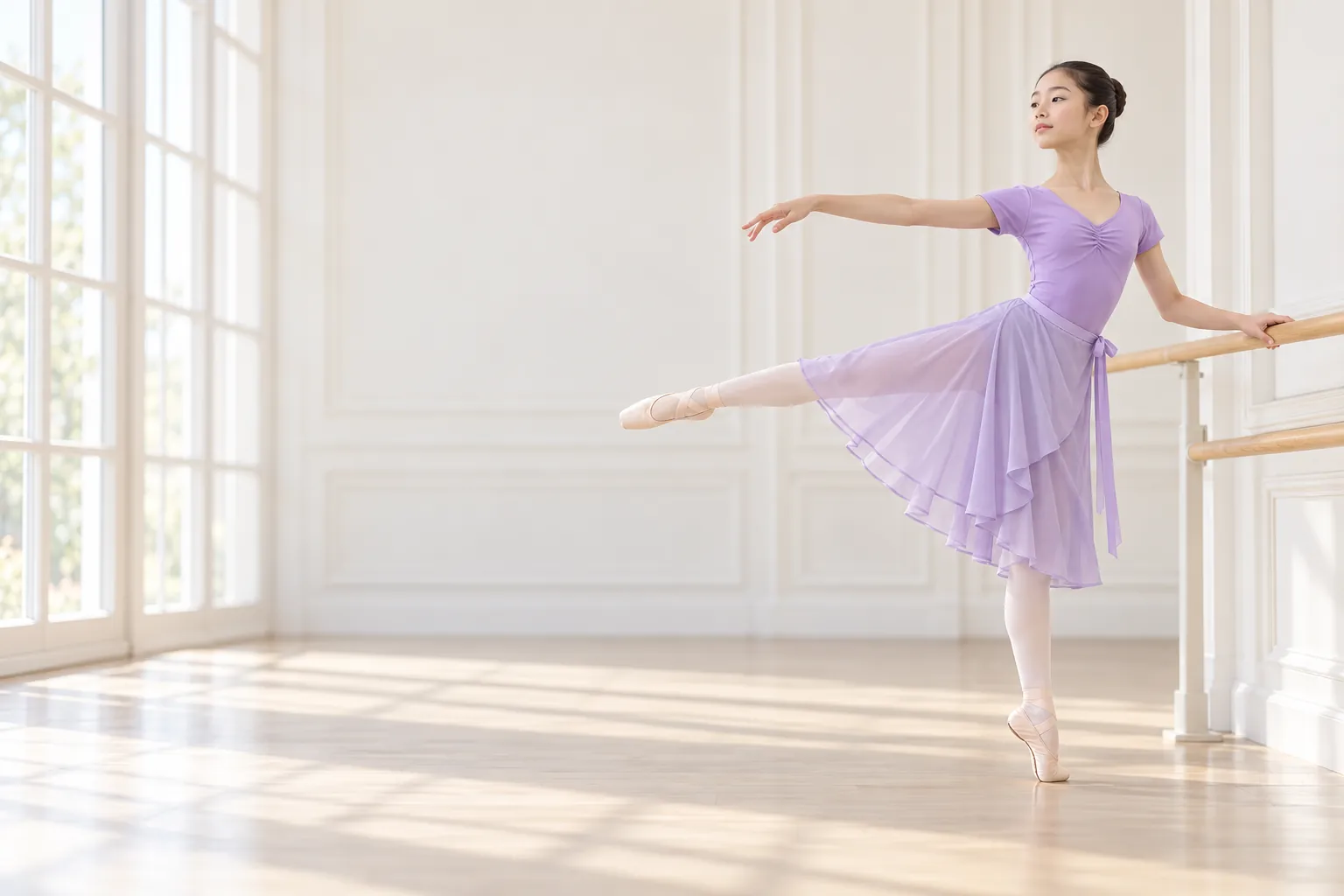
Short answer: the main ballet skirts are wrap skirts (tied at the waist), pull-on skirts (with an elastic waist), chiffon or georgette skirts (light and flowing), mesh skirts (a little firmer) and tulle skirts (soft and full). Chiffon wrap and pull-on skirts are the most common in class.
What are the main types?
| Type | Fabric | How it fastens | Best for |
|---|---|---|---|
| Wrap skirt | Chiffon or georgette | Ties at the waist | Class, teens and adults |
| Pull-on skirt | Chiffon or mesh | Elastic waist | Young children |
| Chiffon skirt | Light, flowing | Wrap or elastic | Class and exams |
| Mesh skirt | Firmer, slightly sheer | Elastic | Class, with more body |
| Tulle skirt | Soft, full net | Elastic | Early Years and performance |
How do I choose?
- Age. Young children usually find pull-on skirts easiest. Older dancers like the adjustable wrap.
- School rules. Some schools require a skirt for certain levels and a specific color.
- Movement. Choose a skirt light enough to move without covering the legs.
- Length. Short to mid-thigh for beginners, longer for older dancers if the school allows it.
What is the difference between chiffon and mesh?
Chiffon is very light and floats when the dancer moves. Mesh has a bit more body, so it keeps its shape and does not cling. Both are used for ballet skirts, and the choice is mostly about the look and feel the dancer prefers.
Are skirts required for ballet class?
Not always. Some schools require one at certain levels, others do not. Skirts are often removed for the barre if the teacher asks. Always check your uniform list.
How do I look after them?
- Wash gently in cool water, in a mesh bag, or by hand.
- Do not wring or tumble dry.
- Hang to dry. Iron on low only if needed, with a cloth over the fabric.
- Store hung or flat to prevent creases.
How do I choose the size?
Use waist and height. A wrap skirt should overlap by a few inches, while a pull-on skirt should sit comfortably without rolling. See our size guide, and size up if between sizes.
How long should a ballet skirt be?
For beginners, a short skirt at the thigh or just above the knee is the usual choice. It lets the teacher see the knees and legs clearly. For older dancers, a longer chiffon skirt to the knee or mid-calf looks elegant and is used for some classes and performances. Always check whether your school sets a maximum length.
What colors are common?
- Black. Classic and smart, common at older levels.
- Ballet pink. Traditional for younger dancers.
- Lilac, lavender and pale blue. Popular pastel choices.
- White. Used for Early Years and performances.
How should a skirt move?
A good ballet skirt floats during a turn and settles softly. If it clings to the legs or hides them, it is too heavy. If it flies up too quickly, it may be too light for class. Try the skirt on at home with a simple turn to check it moves well.
Should I buy more than one?
One skirt is enough to start. A second in a different color gives variety, and a spare is useful if one is in the wash. Keep a skirt for exams or shows that is only worn for those occasions.
Frequently asked questions
What is a ballet wrap skirt?
A ballet wrap skirt is a light skirt that wraps around the waist and ties, so it adjusts to different sizes.
What is the difference between a wrap skirt and a pull-on skirt?
A wrap skirt ties at the waist and adjusts. A pull-on skirt has an elastic waist and is quicker for young children.
What fabric are ballet skirts made of?
Chiffon, georgette, mesh or tulle, depending on the style and the look.
Do you wear a skirt in ballet class?
It depends on your school. Some levels require one and others do not.
How do I wash a chiffon ballet skirt?
Wash gently in cool water, in a mesh bag or by hand, and hang to dry.