
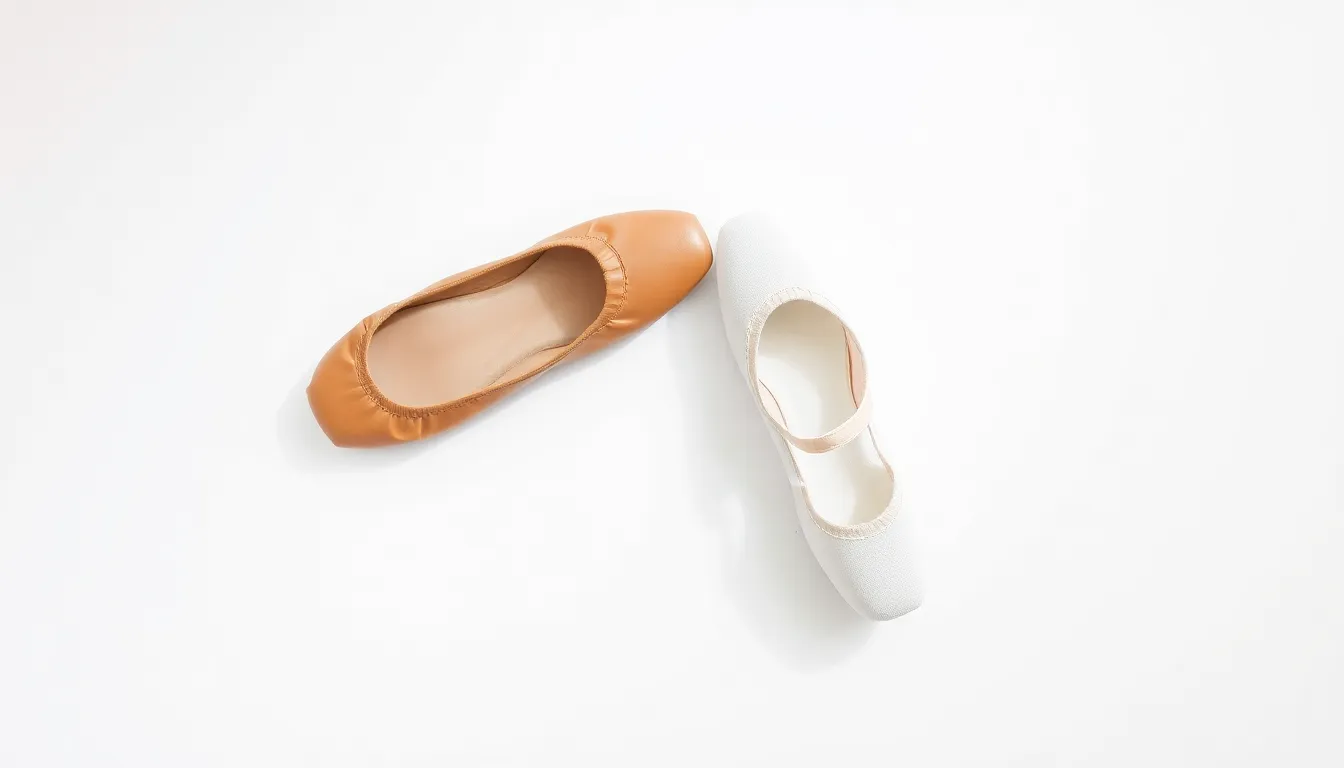
Ballet slippers and ballet shoes are the same thing: a soft, lightweight flat dance shoe worn for ballet class, examinations and rehearsal. The terms are used interchangeably. Both refer to the flat canvas or leather shoe worn for floor-based training — not to be confused with pointe shoes (the hard-toed shoes used for dancing en pointe) or character shoes (the heeled shoes used for character dance examinations).
Why Are They Called Both Slippers and Shoes?
The word “slipper” reflects the shoe’s soft, slip-on construction — there are no laces, buckles or fastenings beyond a simple drawstring at the toe. In the UK, “ballet slipper” and “ballet shoe” are both widely used. In the US, “ballet slipper” tends to be the more common term for the flat training shoe. Either name refers to the same product: a soft, flexible, flat shoe with a fabric or leather upper and a thin sole.
Full Sole vs Split Sole Ballet Slippers
Full-sole ballet slippers have a single piece of leather or suede running the entire length of the shoe sole. They provide more resistance when the foot points and are traditionally recommended for beginners and younger students whose foot muscles are still developing. Split-sole ballet slippers have two separate sole sections — one at the ball of the foot and one at the heel — with nothing across the arch. The arch is free to flex and point fully, which gives a cleaner aesthetic line and is preferred by more advanced students.
Canvas vs Leather Ballet Slippers
Canvas ballet slippers are lighter, cheaper, machine-washable and mould quickly to the shape of the foot. They are the most popular choice for children in regular classes. Leather ballet slippers are more durable, mould to the foot over time and offer a more defined shape against the foot. They are preferred in many professional training contexts and by students who want a longer-lasting shoe. Both are available in full-sole and split-sole styles.
Ballet Slippers for Girls vs Women vs Boys
Girls’ ballet slippers are most commonly pink — either pale pink or theatrical pink depending on the school. Women’s ballet slippers are available in pink, black and nude tones. Boys’ and men’s slippers are white or black. The construction is the same across all versions; only the colour and sometimes the width fitting differ. Some brands offer wider fittings for broader feet.
How Should Ballet Slippers Fit?
Ballet slippers should fit snugly with no excess fabric at the toe box, but the toes should not be forced into a curl. There should be no gaping at the heel or sides. The elastic across the instep should hold the shoe firmly without digging in. Try slippers on with ballet tights — not thick socks — and check the fit in a plié and a relevé. A well-fitting slipper should feel like a second skin: secure, but never restricting.
Frequently Asked Questions
Are ballet slippers the same as pointe shoes?
No. Ballet slippers (flat training shoes) and pointe shoes are completely different. Ballet slippers are soft and flexible and used for all floor-based training. Pointe shoes have a hard box and a rigid shank that support the dancer on the tips of the toes — they are only introduced when a teacher confirms the student is ready, usually at Grade 5 RAD or equivalent.
Can ballet slippers be worn outside?
Ballet slippers are not designed for outdoor use. The thin suede or leather sole wears through very quickly on outdoor surfaces, and dirt and grit from outside damages the studio floor. Always change into ballet shoes inside the studio.
How long do ballet slippers last?
Canvas slippers typically last 6–12 months of regular class use. Leather slippers last 12–24 months. Replace them when the sole develops holes, the upper splits or the elastic loses its stretch.