
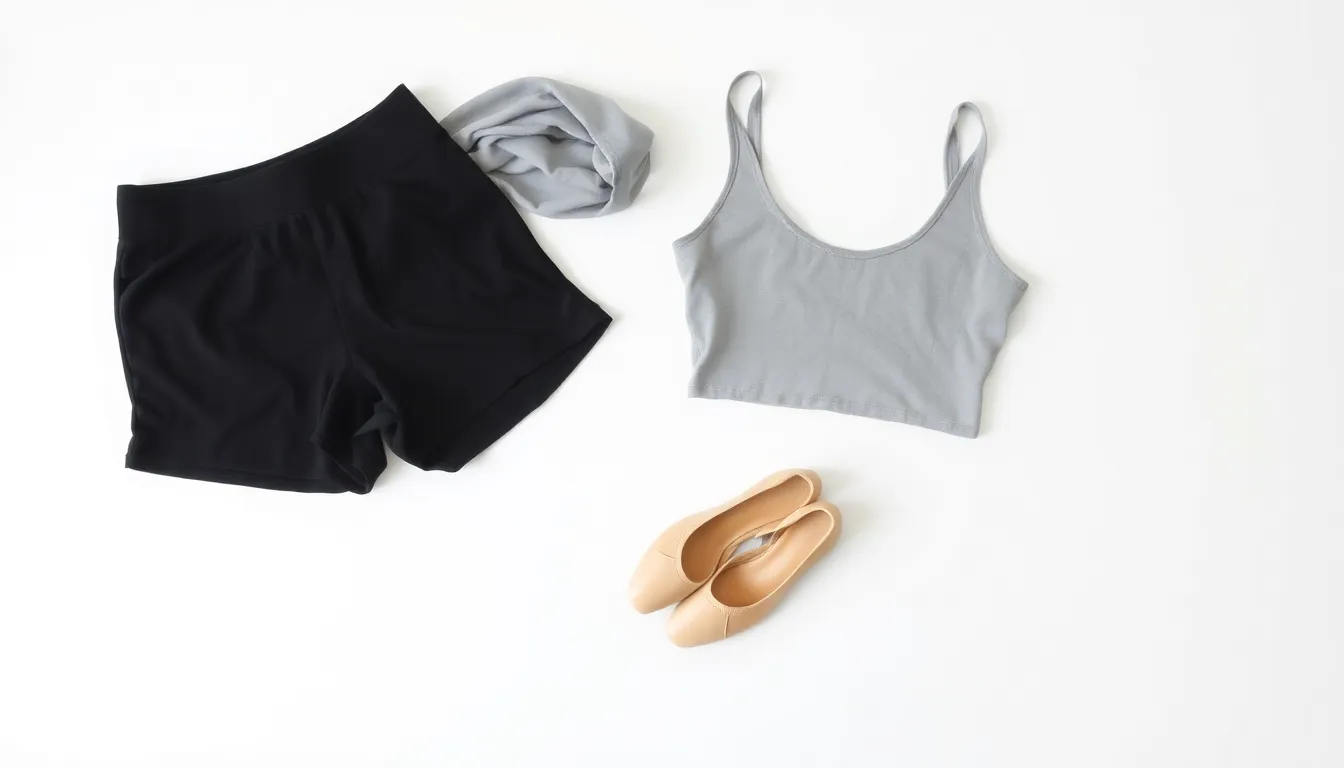
Contemporary dance and lyrical dance classes typically have a flexible dress code: fitted clothing that allows a full range of movement, bare feet or soft shoes, and hair tied back. Unlike classical ballet, there is rarely a specific colour or uniform requirement. The goal is clothing that lets the teacher see your body alignment and that moves with you — not constrains you.
Top and Torso: What Works Best
A fitted crop top, dance vest or camisole leotard are all suitable for contemporary and lyrical classes. The teacher needs to see your spine, ribcage and shoulder alignment, so avoid baggy T-shirts or oversized jumpers during exercises. Many students wear a leotard as a base layer and add a fitted crop top or long-sleeve layer over it for warmth during the warm-up. Black, navy and earth tones are most common in contemporary classes — there is no colour requirement.
Bottoms: Shorts, Leggings or Flares
High-waist dance shorts (mid-thigh length), fitted leggings and wide-leg dance trousers are all common in contemporary and lyrical classes. Flared yoga trousers and palazzo dance pants are popular for lyrical styles where the flow of the fabric is part of the aesthetic. Avoid very tight gym leggings that restrict hip rotation or rise up during floorwork. Fitted leggings in a matte stretch fabric are the most practical all-purpose option.
Feet: Bare, Half Sole or Lyrical Shoes
Many contemporary teachers prefer bare feet so students can feel the floor and use the intrinsic muscles of the foot fully. Half-sole shoes (also called pirouette shoes or turning shoes) cover only the ball of the foot and toes, leaving the heel bare — they allow floor contact while protecting the skin during turns and slides. Lyrical shoes are a soft, flexible full-shoe option that covers the whole foot in a thin canvas or mesh upper with a suede sole. Which you use depends on the teacher’s preference and the studio floor surface.
Hair and Accessories
Hair must be tied back — a bun, ponytail or braid. Loose hair catches during turns and obscures the neck and shoulder lines. Contemporary classes do not require a formal ballet bun, so a secure ponytail or messy bun is fine. Avoid jewellery that could catch on fabric or another dancer during partner work or contact improvisation sections.
Layering for Contemporary Dance
Many contemporary students arrive in a warm-up layer: a hoodie, wrap cardigan or oversized knit top. This goes on before class and during breaks, and comes off when the body is warm. Studios with wooden sprung floors can be cold, and keeping muscles warm reduces injury risk. A dance belt is required for male students as in any other dance class.
Frequently Asked Questions
Can I wear a ballet leotard for contemporary class?
Yes — a leotard and footless tights or a leotard with fitted shorts is a practical and widely accepted outfit for contemporary class. Many students who do both ballet and contemporary simply keep the same base layer and change their shoes.
Do I need specific lyrical shoes?
Not always. Many teachers allow bare feet or half-sole shoes. Lyrical shoes are useful if the studio has a rough floor surface that scratches bare feet, or if you are performing in a recital where the stage surface requires some sole coverage. Check with your teacher before buying.
What is the difference between contemporary and lyrical dance clothing?
In practice, the dress codes for contemporary and lyrical classes overlap significantly. Lyrical styles tend toward softer, more flowing fabrics — wide-leg trousers, chiffon layers. Contemporary may be more minimal: a leotard, shorts and bare feet. Both prioritise freedom of movement over aesthetics.