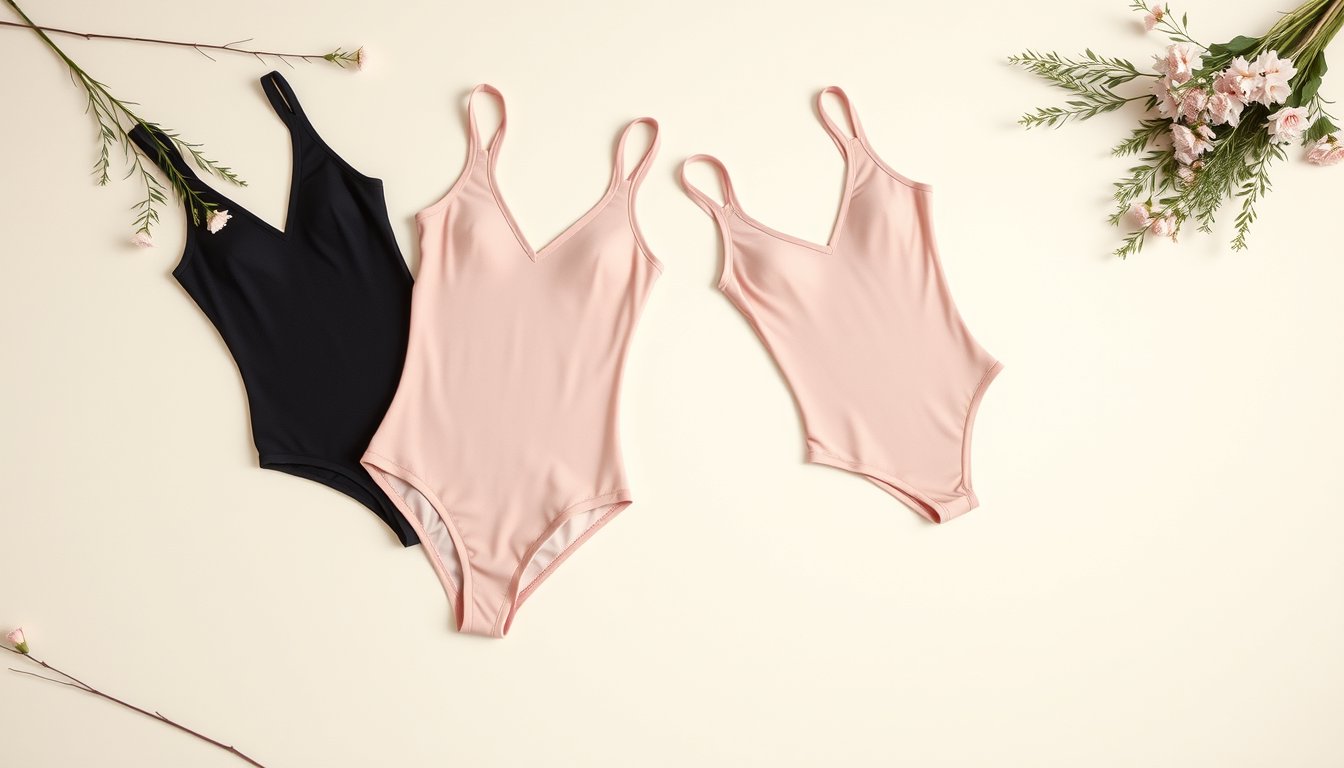
Short answer: a leotard covers the torso and leaves the legs bare, while a unitard is a one-piece garment that also covers the legs, to the knee or the ankle. Ballet class almost always uses a leotard with tights. A unitard is more common in contemporary and modern dance, rehearsals and some performances.
What is the difference between a unitard and a leotard?
| Leotard | Unitard | |
|---|---|---|
| Legs | Bare, usually worn with tights | Covered, to the knee or to the ankle |
| Sleeves | Straps, short, long or none | Straps, short, long or none |
| Typical use | Ballet class, exams, rehearsal | Contemporary, modern, rehearsal, stage |
| Layering | Tights, skirt or warm-ups over or under | Often worn alone |
| Teacher can see the leg line | Yes, with fitted tights | Yes, if fitted and smooth |
Which one should I wear to ballet class?
Choose the leotard and tights unless your teacher says otherwise. Ballet teachers want to see the position of the hips, knees and feet, and a leotard with fitted tights shows the legs clearly. Many schools also list the leotard color and style in their uniform. A unitard is fine for many adult and contemporary classes, but ask first before you buy one for an exam or graded class.
When is a unitard a good choice?
- Contemporary or modern classes, where floor work and rolls are common and full coverage is comfortable.
- Cold studios, where a long-sleeved unitard keeps the whole body warm.
- Rehearsals and performances where the costume calls for a clean, one-color line.
- Dancers who prefer full coverage and do not want to manage separate tights.
What should I check when buying either one?
- Stretch. It should move with the arms, back and hips without pulling.
- Length. A unitard must be long enough in the torso and legs, or it will pull at the shoulders and knees.
- Lining. A lined front adds coverage and comfort.
- Fabric. Cotton blends feel soft and breathe. Nylon blends feel smooth and dry quickly.
- Fit. Choose by height first, then check the chest and torso. If between sizes, choose the larger one. See our size guide.
Is a unitard the same as a bodysuit or a catsuit?
The words overlap. A bodysuit usually has legs that stop at the hip, so it is closer to a leotard. A catsuit is a long, fitted fashion garment. In dance shops, a unitard is the name for the full-length dance garment.
How do I look after them?
Wash on a gentle, cool cycle, avoid fabric softener and bleach, and air dry. Heat can wear out the elastic. Two garments in rotation last longer than one worn every day.
Common mistakes when choosing a unitard
- Buying by age. Torso length decides the fit, so measure height and check the chart.
- Choosing a thick fabric. Heavy fabric traps heat in a busy class.
- Skipping the sit test. Sit, bend and raise the arms in the fitting. Nothing should pull.
- Forgetting the school rule. Some schools name a leotard style in the uniform list.
If you are still unsure, start with a leotard and tights. It is the standard ballet uniform and works in almost every class, and you can add a unitard later for contemporary or rehearsal days. Our leotard style guide shows the neckline and strap options.
Shop from Zoe Dancewear
What about a black unitard or a dance unitard?
A black unitard is a practical base layer for modern and contemporary classes, and a good choice for dancers who prefer full coverage. Dance unitards are also used as costumes. For ballet class, a leotard with tights is usually the standard, so check the dress code first. See also our guide to bodysuits and body tights.
What are women’s, men’s and black dance unitards?
A unitard is a one-piece that covers the torso and legs. Women’s unitards are used in modern, contemporary and jazz classes and on stage. Men’s unitards are worn over a dance belt, and the black unitard is the easiest base layer because it goes with everything. For ballet class, a leotard with tights is still the usual standard, so check your dress code first. See our guide to men’s leotards and unitards.
Can I wear a white unitard?
A white unitard is used for stage looks and for some classes, but check your school’s dress code first. White fabric can show through when it is thin, so choose a lined or thicker unitard and wear skin-tone underwear. Black is easier for daily class. For more, see men’s leotards and unitards.
Frequently Asked Questions
Can a student wear a unitard instead of a leotard to RAD ballet class?
For most RAD graded classes, the required uniform specifies a leotard and tights. A unitard is not a direct substitute because it does not show the leg line in the same way. Some contemporary or modern dance classes accept unitards — check with your teacher.
Are unitards warmer than leotards for cold studios?
Yes — a unitard that covers the legs provides extra warmth without the need for separate warm-up pants. They are popular in contemporary dance classes held in cooler rehearsal spaces.
Is a unitard easier to wear than a leotard and tights?
For adults and older teens, many find a unitard simpler because it is one garment rather than two layers. For young children, the all-in-one design can make toilet breaks more complicated, which is why leotard and tights remains the standard for younger students.
Frequently asked questions
What is a unitard?
A unitard is a fitted one-piece garment that covers the torso and the legs, to the knee or the ankle. Dancers wear it for contemporary and modern dance, rehearsals and some performances.
What is the difference between a leotard and a unitard?
A leotard covers the torso and leaves the legs bare, so it is usually worn with tights. A unitard also covers the legs.
Can you wear a unitard to ballet class?
Some adult and contemporary classes allow it, but most ballet classes ask for a leotard and tights. Ask your teacher first.
Can I wear a unitard for a ballet exam?
Usually not. Exam uniform is normally a leotard and tights in the school's chosen style. Check with your teacher and the current requirements.
Is a unitard warmer than a leotard?
A long-sleeved unitard covers more of the body, so it is warmer, but a leotard with tights and warm-ups can be just as warm and is easier to take off in layers.