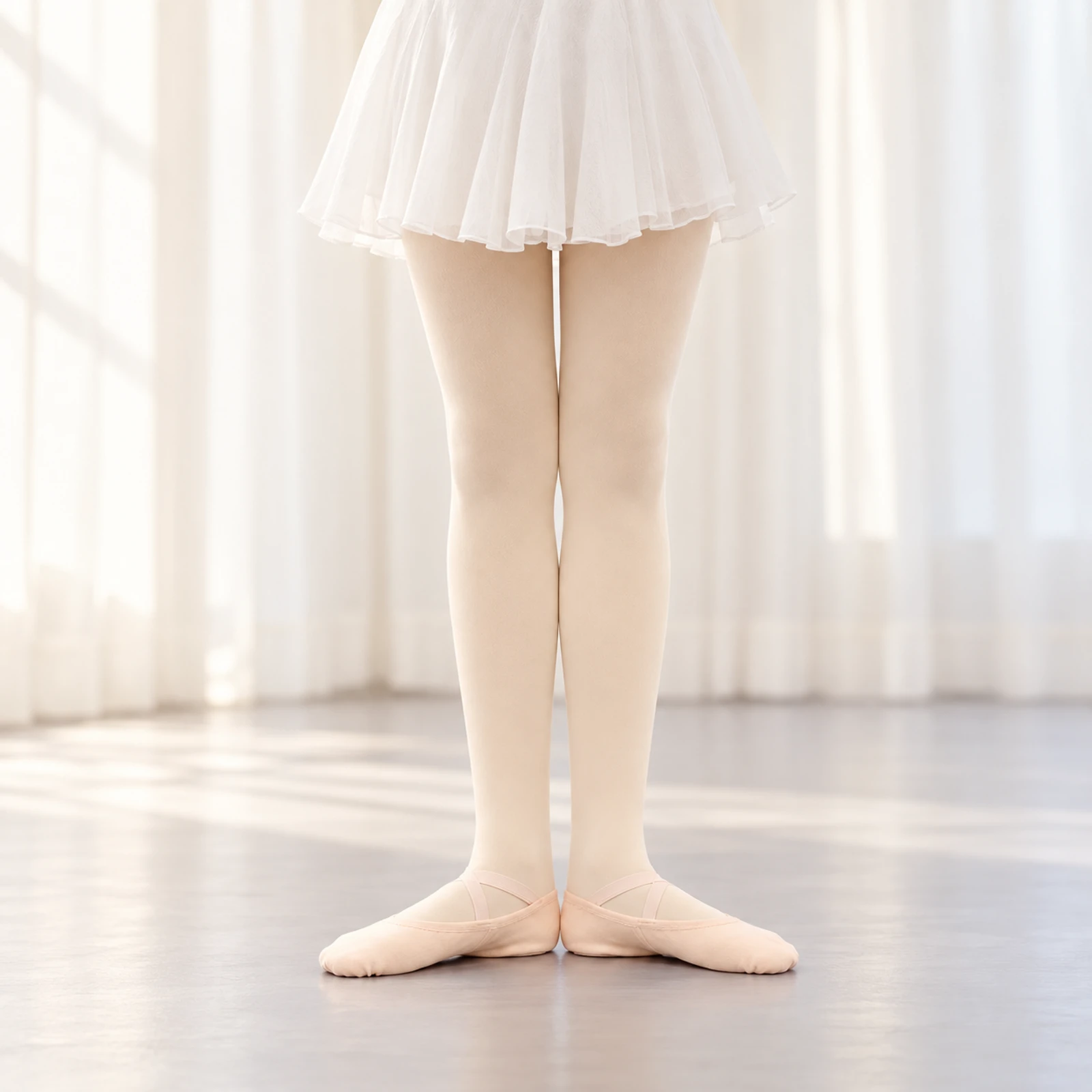
Short answer: footless tights end at the ankle, so the foot is bare. Dancers wear them for modern, jazz, floor work, barefoot classes, and when they want to see the foot. For ballet class in ballet shoes, most teachers prefer footed or convertible tights, so the line of the leg continues smoothly into the shoe.
What are footless tights?
Footless tights cover the legs and end at the ankle or the ball of the foot, with no foot part. They are close to leggings, but made in a smooth, stretchy dance fabric. Some have a small stirrup that loops under the arch to keep them in place.
Footless, footed and convertible tights compared
| Footless | Footed | Convertible | |
|---|---|---|---|
| Foot | Bare | Covered | Covered, with a hole to roll the foot up |
| Best for | Modern, jazz, floor work, barefoot | Ballet class and exams in ballet shoes | Both, or when you want a choice |
| Line of the leg | Stops at the ankle | Continues into the shoe | Either |
Our guide to footed, convertible and stirrup tights shows the differences in more detail.
When should I wear footless tights?
- Modern and contemporary classes, where bare feet are normal.
- Jazz and floor work, where grip on the floor matters.
- Warm studios, when you prefer less covering.
- With ballet shoes at home, if you do not mind the look.
Can I wear footless tights to ballet class?
Some adult and informal classes allow them. Many ballet teachers and schools prefer footed or convertible tights, because they want to see the full line of the leg and foot. Check with your teacher before you buy.
How do I choose the right pair?
- Size by height and weight. Use the size chart, and if you are between sizes choose the larger one. See our tights size guide.
- Fabric. Look for a smooth nylon and spandex blend that does not bag at the knee.
- Waist. A soft, flat waistband that does not roll or dig in.
- Color. Black is the most practical, and a skin-tone shade gives a continuous leg line. See our guide to pink or skin-tone tights.
Are footless tights the same as leggings?
They look similar, but dance footless tights are usually thinner, smoother and designed to be worn under a leotard and skirt. Leggings are thicker and made for everyday wear. Our guide to tights vs leggings has the details.
How do I look after them?
Wash on a gentle cycle in cool water, and let them air dry. Avoid fabric softener and high heat, which wear out the elastic. Take off rings and trim nails to avoid snags.
Footless tights for children
For young dancers, footed or convertible tights are usually easier at ballet class, because they stay in place inside ballet shoes. Footless tights suit creative movement, modern and jazz classes, and barefoot play. Check the length: a pair that is too short rides up and pulls at the knee.
Common mistakes when buying footless tights
- Buying them for ballet shoes. The tights ride up and bunch at the ankle, so use footed or convertible tights instead.
- Choosing the wrong length. Check the leg length, not only the waist.
- Using thick leggings. Dance footless tights are thinner and smoother than everyday leggings.
Frequently asked questions
What are footless tights?
Tights that end at the ankle and leave the foot bare.
Can you wear footless tights to ballet class?
Some classes allow them, but most ballet teachers prefer footed or convertible tights. Ask your teacher.
What are footless tights used for in dance?
Mainly for modern, jazz, floor work and barefoot classes.
Are footless tights the same as leggings?
No. Dance footless tights are thinner and smoother, made to wear under a leotard and skirt.
What size footless tights should I buy?
Choose by height and weight on the size chart, and go up a size if between sizes.