
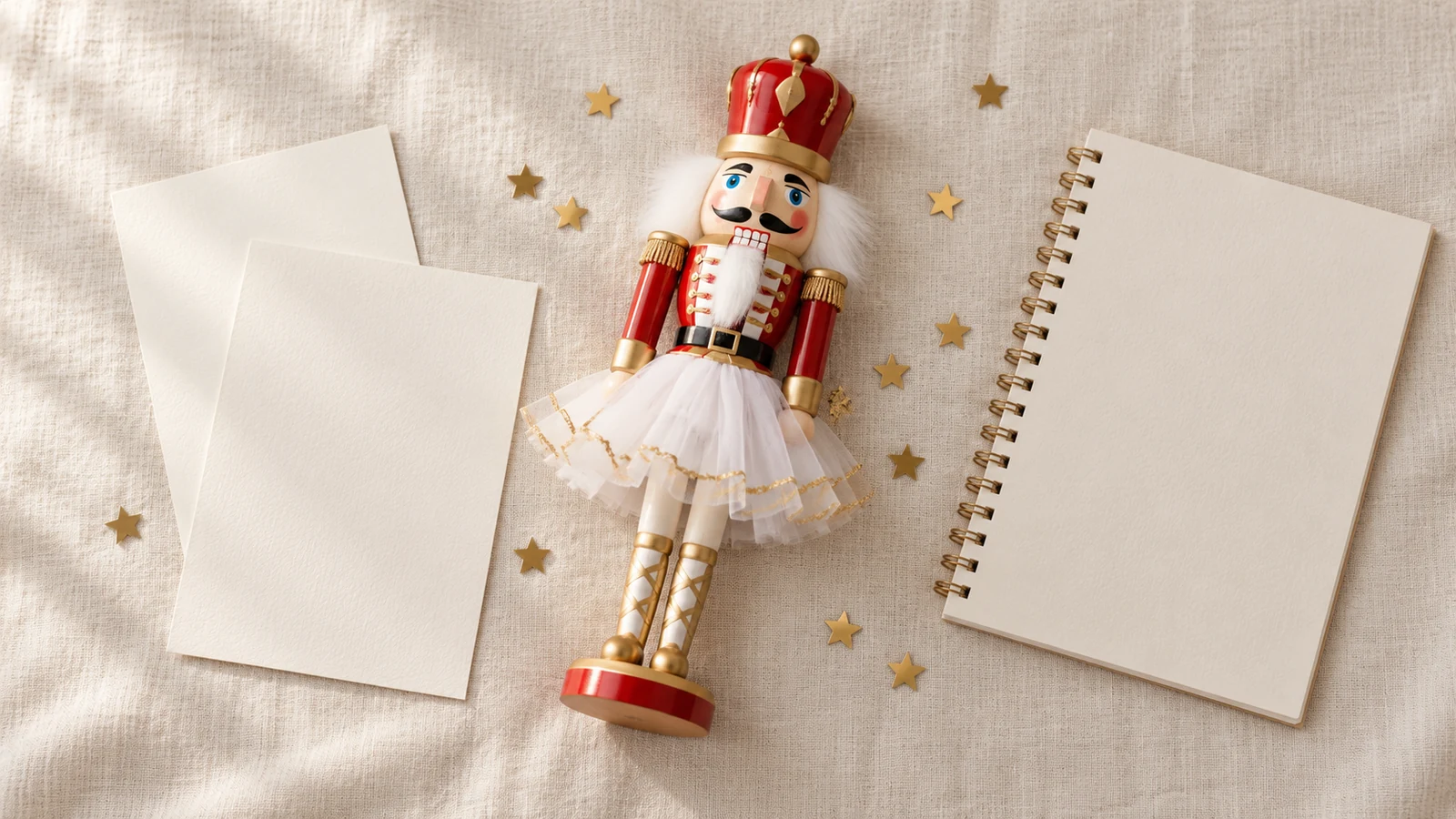
Why The Nutcracker Matters for Dance Families
The Nutcracker is the most performed ballet in the world. Virtually every ballet school stages a version at Christmas, and millions of children see it as their first live ballet performance. Knowing the characters before you go makes the experience far richer — especially for young audience members following their first full-length story ballet.
The Main Characters in The Nutcracker
Clara (or Marie)
The story’s heroine — a young girl celebrating Christmas Eve with her family. In some productions she is called Clara, in others Marie. She receives a nutcracker doll as a gift from her mysterious godfather Drosselmeyer, and it is her bravery that saves the Nutcracker Prince during the battle with the Mouse King. Clara is usually danced by a young student from the company’s school — often one of the first major roles a young dancer performs on a professional stage.
The Nutcracker / The Nutcracker Prince
The enchanted doll that Clara receives as a Christmas gift. At midnight, the Nutcracker comes to life and leads the toy soldiers against the Mouse King’s army. After the battle, he is revealed to be a prince who has been under a spell. He takes Clara on a magical journey through the Land of Snow and into the Kingdom of Sweets.
Drosselmeyer
Clara’s eccentric godfather — a mysterious, one-eyed toymaker who arrives at the Christmas party with extraordinary mechanical toys and, of course, the nutcracker doll. Drosselmeyer is a dramatic character role, usually played by a senior male dancer. He guides Clara through the fantasy world and may have a deeper connection to the Nutcracker Prince depending on the production.
The Sugar Plum Fairy
The ruler of the Kingdom of Sweets who welcomes Clara and the Prince. The Sugar Plum Fairy’s grand pas de deux in Act II is one of the most technically demanding and celebrated passages in the classical ballet repertoire. Her solo variation and the duet with her Cavalier are what most audiences come to see. This role is always danced by the company’s leading ballerina.
The Cavalier (Sugar Plum Fairy’s Partner)
The Sugar Plum Fairy’s partner in the Act II grand pas de deux. In some productions he is identified with the Nutcracker Prince. The Cavalier’s role requires exceptional partnering skill, strong jumps, and elegant turns.
The Mouse King
The villain of Act I, leading his army of mice against the Nutcracker’s toy soldiers. The Mouse King has seven heads in the original story; most stage productions simplify this to a single crowned figure in a dramatic mouse costume. He is defeated when Clara throws her shoe at him.
The Divertissement Characters: The Kingdom of Sweets
Act II features a series of dances performed in honor of Clara and the Prince. These character dances represent different sweets and countries:
- Spanish (Hot Chocolate) — bold and dramatic, castanets and passionate footwork
- Arabian (Coffee) — slow and exotic, often featuring a sinuous solo or trio
- Chinese (Tea) — quick and light, with acrobatic touches
- Russian (Candy Canes / Trepak) — high-energy, featuring athletic jumps and turns
- Danish (Marzipan Shepherdesses) — delicate and charming, usually performed by younger dancers or students
- Mother Ginger and her Children (Polichinelles) — a comic scene where small children emerge from under Mother Ginger’s enormous skirt
- Waltz of the Flowers — a large ensemble piece for the corps de ballet, one of Tchaikovsky’s most beloved passages
Productions Vary — What to Expect
No two Nutcracker productions are exactly alike. The Royal Ballet’s version differs from American Ballet Theatre’s, which differs again from a regional company’s staging. Some versions update the setting or costumes; others add storyline changes. Check the program notes for the specific production you are attending.
Frequently Asked Questions
How old is the role of Clara typically danced by?
At professional companies, Clara is usually danced by a student from the company’s affiliated school, typically aged 10 to 14 depending on the production’s physical requirements. In amateur productions, the age range is wider.
Is the Nutcracker suitable for very young children?
Most productions are appropriate for children aged 4 and over. The battle scene between the toy soldiers and mice can be exciting and slightly scary for very young children, but it is brief. The second act is gentle and magical throughout. Check the production’s recommended age guidance when booking.
Which Nutcracker music is most famous?
The Dance of the Sugar Plum Fairy (featuring the celesta), the Waltz of the Snowflakes, the Arabian Dance, and the Russian Trepak are the most widely recognized pieces. The entire score is by Pyotr Ilyich Tchaikovsky, composed in 1892.
Does Clara dance the whole ballet?
In traditional productions, Clara’s role in Act II is largely as an observer — she watches the divertissements and the Sugar Plum Fairy’s grand pas de deux. Some modern productions give Clara a more active dancing role throughout.