Posted on

Gaynor Minden Pointe Shoes: What Makes Them Different

Gaynor Minden Pointe Shoes: What Makes Them Different

What Are Gaynor Minden Pointe Shoes?

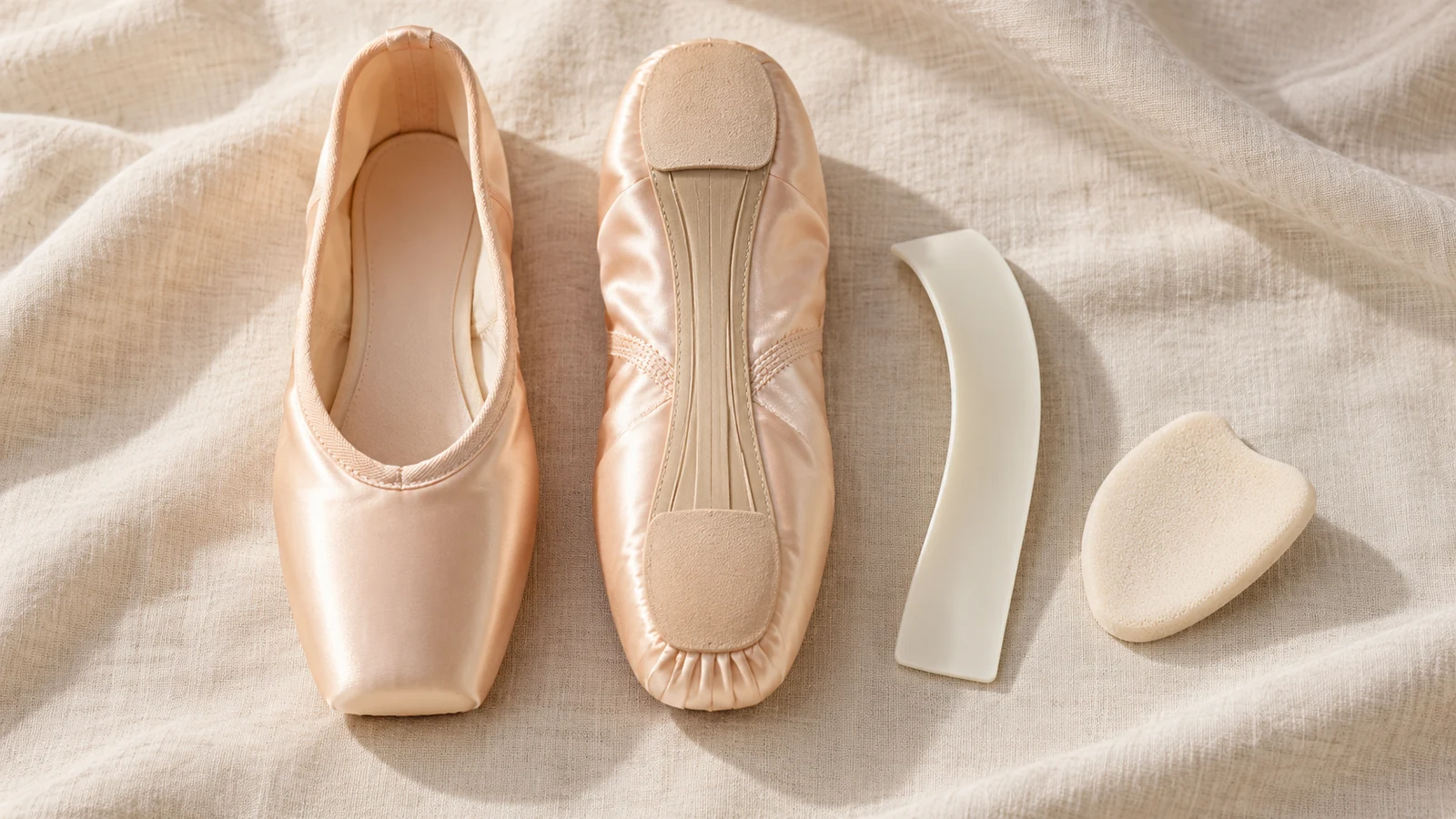
Gaynor Minden is an American pointe shoe brand, founded in New York in 1991 by pointe shoe specialist Eliza Minden and musician Arnold Gaynor. Their shoes are constructed using polyurethane elastomers rather than the traditional paste, cardboard, and burlap construction of conventional pointe shoes — making them one of the most significant innovations in pointe shoe design in the past century.

Professional dancers, dance schools, and pointe shoe fitters worldwide stock Gaynor Mindens, and they have developed a devoted following among dancers who find traditional shoes problematic. Understanding what makes them different helps you have informed conversations with your fitter.

Traditional Pointe Shoe Construction vs Gaynor Minden

Traditional Construction

Conventional pointe shoes (Bloch, Freed, Capezio, Grishko, Merlet, and others) are made using layers of fabric, cardboard, and paper, bonded with paste and shaped by hand. The box (the toe platform) hardened with paste, and the shank (the stiff insole) is made of cardboard or leather. These shoes “break in” as the paste softens with use, and they “die” — lose their support — after a certain number of hours on pointe that varies with the dancer’s weight, foot type, and sweating.

Gaynor Minden Construction

Gaynor Minden replaces the paste-hardened box with a moulded polyurethane elastomer toe box, and offers a range of shank materials including their signature elastomer shank. The result is a shoe that:

  • Requires little or no traditional break-in period
  • Maintains its shape and support significantly longer than traditional shoes
  • Does not soften and collapse in the same way when wet from sweat
  • Is quieter than many traditional shoes

The Gaynor Minden Fitting System

One distinctive feature of Gaynor Minden shoes is their highly customisable fit system. Dancers choose not only size and width but also:

  • Box shape — standard (tapered), medium, or wide platform
  • Shank strength — from flexible to extra-firm, in half-increments
  • Vamp length — standard or low-cut (for dancers with short vamps or high insteps)
  • Heel shape — standard or narrow
  • Platform width — for the amount of standing surface on the box

This level of customisation means that Gaynor Minden can work extremely well for difficult feet that are hard to fit in traditional shoes — but it also means that an unsupervised online purchase is a poor idea. These shoes must be professionally fitted.

Who Are Gaynor Minden Shoes For?

Gaynor Minden shoes work particularly well for:

  • Dancers with strong, meaty feet that kill traditional shoes quickly
  • Dancers with high arches who find traditional shoes collapse before the shank breaks in
  • Students returning from injury who need consistent, predictable support
  • Recreational or pre-professional students who do not dance enough hours weekly to break in a traditional shoe before it becomes too soft

They may be less ideal for:

  • Students in the earliest stages of pointe training, whose teachers prefer to work with a shoe that breaks in progressively
  • Dancers whose teachers and companies require a specific traditional brand

Cost and Durability

Gaynor Minden shoes typically cost more than entry-level traditional pointe shoes but less than premium traditional brands. Their significantly longer lifespan (many dancers report two to three times the durability of traditional shoes) means the cost per hour of dancing is often comparable or lower over time.

Frequently Asked Questions

Are Gaynor Minden shoes approved for RAD examinations?

There is no specific brand restriction in RAD examinations — the requirement is an appropriate pointe shoe. Always check with your teacher before purchasing any pointe shoe for examination use.

Can I buy Gaynor Minden shoes online?

You can order them online, but this is not recommended. The multi-variable fitting system means that the optimal combination for your foot is genuinely difficult to determine without a professional fitting session. Order through a specialist dance retailer who can advise on the correct specifications for your foot type.

Do professional dancers use Gaynor Minden?

Yes — a significant number of professional dancers use Gaynor Minden shoes, particularly in the United States. Others prefer traditional brands. At the professional level, shoe choice is highly personal and is informed by foot type, company requirements, and individual preference. There is no universally “best” pointe shoe brand; fit is everything.

Posted on

Best Ballet Books and Dancer Biographies: A Reading List

Best Ballet Books and Dancer Biographies: A Reading List

Why Read About Ballet?

Ballet is a performing art that exists in the moment of performance — but the stories behind the dancers, the companies, and the choreographers are rich, dramatic, and deeply illuminating. Reading about ballet deepens a dancer’s understanding of the art form, inspires young students, and gives dance parents a window into a world they may be new to. These are the books most consistently recommended by dancers, teachers, and dance educators.

Autobiographies and Memoirs

Dancing on My Grave — Gelsey Kirkland

One of the most brutally honest and compulsively readable books ever written about the ballet world. Gelsey Kirkland was one of the greatest American ballerinas of the 1970s — a principal dancer with NYCB and ABT, the original Juliet opposite Mikhail Baryshnikov. This memoir documents both the extraordinary artistry of that era and the darker realities of eating disorders, drug use, and the physical and psychological demands placed on dancers. It is not suitable for young children but is essential reading for older teenagers and adults serious about understanding the profession.

Every Step You Take — Margot Fonteyn

Fonteyn’s own account of her extraordinary life and career is warm, witty, and beautifully written. It covers her training, her decades at the Royal Ballet, her legendary partnership with Rudolf Nureyev, and her life in Panama. Essential reading for any admirer of the Royal Ballet’s history.

Maria Tallchief: America’s Prima Ballerina — Maria Tallchief with Larry Kaplan

Tallchief’s memoir chronicles her upbringing on the Osage reservation, her extraordinary career with New York City Ballet, and her close artistic partnership with George Balanchine. Honest and compelling, it is one of the most important documents in American dance history.

No Fixed Points: Dance in the Twentieth Century — Nancy Reynolds and Malcolm McCormick

Not a memoir but the most comprehensive single-volume history of 20th-century dance ever published. At over 900 pages it is an extraordinary reference work. For serious dance students, their teachers, and dance libraries.

Books for Young Readers

Ballerina Dreams — Lauren Thompson

Based on a true story of five young girls with physical challenges who trained together at Ballet Arts in New York. Inspiring and warm — ideal for children aged 5–8.

Firebird — Misty Copeland, illustrated by Christopher Myers

A picture book written by ABT principal dancer Misty Copeland — one of the most prominent ballerinas of the current era and the first Black female principal at ABT — addressed to a young girl who doubts herself. Beautifully illustrated and moving. Ages 5–9.

Ballet Shoes — Noel Streatfeild

First published in 1936 and never out of print, this classic novel follows three adopted sisters — Pauline, Petrova, and Posy Fossil — at a stage school in London. Posy’s obsessive dedication to ballet is one of children’s literature’s great portraits of a young dancer. Ages 8–12.

Books About Companies and Choreographers

Apollo’s Angels: A History of Ballet — Jennifer Homans

The best single-volume history of classical ballet in print. Homans traces ballet from the French Renaissance through to the present day with both scholarly rigour and genuine passion. Essential for serious dance students and their parents.

Holding It Together — Carlos Acosta

A memoir by the Cuban-born principal dancer who became the first Black Principal Guest Artist at the Royal Ballet. A compelling story of talent, poverty, perseverance, and international success. Suitable for teenage dancers and adult readers.

Frequently Asked Questions

What is the best ballet book for a young child just starting lessons?

Ballet Shoes by Noel Streatfeild (ages 8–12) and Firebird by Misty Copeland (ages 5–9) are both excellent starting points. They capture the dedication, the joy, and the hard work of dance training in ways that inspire rather than overwhelm young readers.

Are there good books about the Royal Ballet?

Yes — Margot Fonteyn’s autobiography is the most personal account of the Royal Ballet’s golden era. Apollo’s Angels by Jennifer Homans covers the Diaghilev era and its influence on British ballet. The Royal Ballet itself has published several commemorative books on its history.

What should dance parents read to understand what their child is learning?

Start with our own guides on ZoeDancewear — the RAD introduction, ballet grades explained, and what is barre? provide the practical context. For a deeper understanding of the art form, Apollo’s Angels is the most accessible serious introduction.

Posted on

The Bolshoi Ballet: History, Dancers and Legacy

The Bolshoi Ballet: History, Dancers and Legacy

What Is the Bolshoi Ballet?

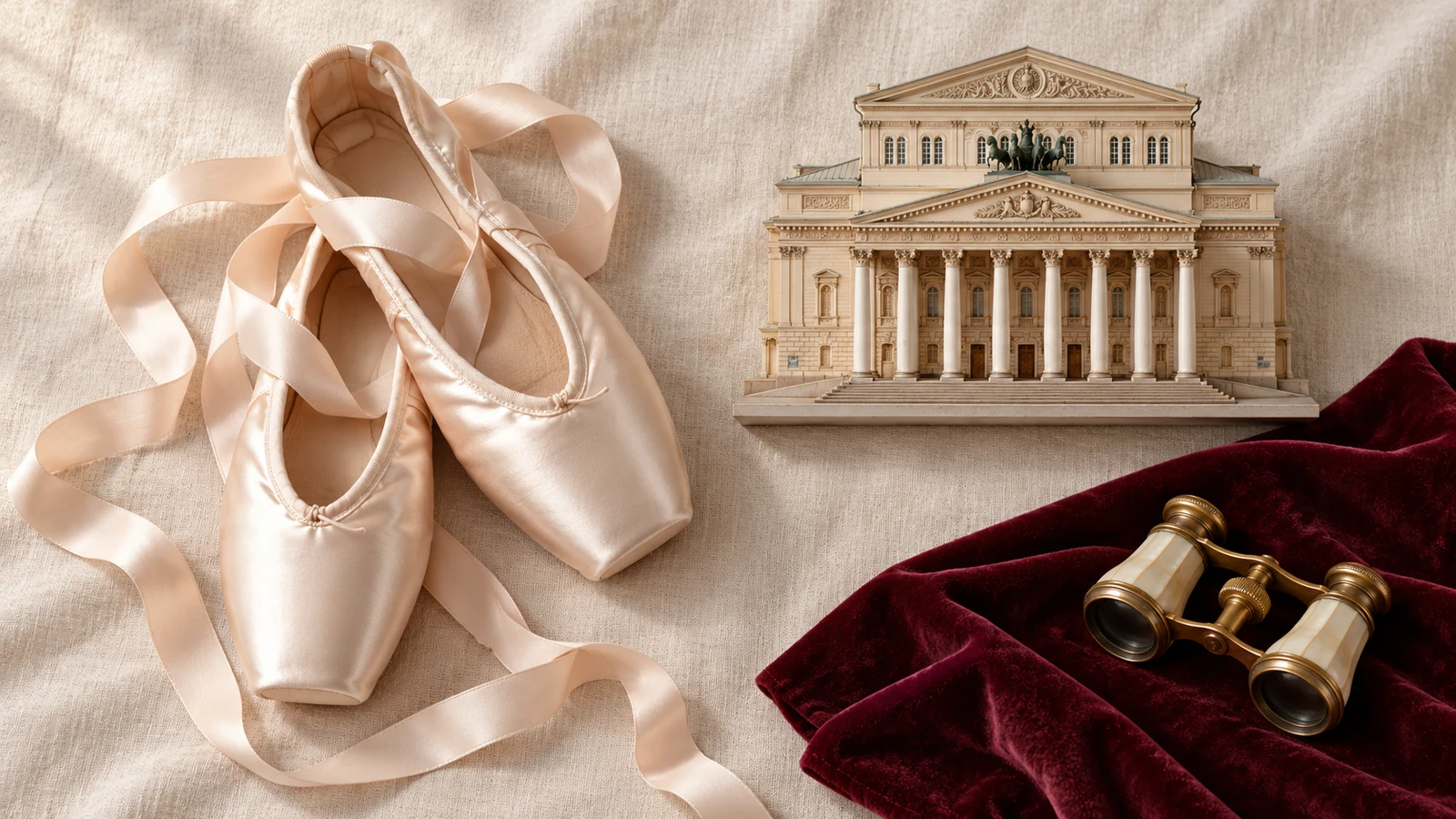
The Bolshoi Ballet is the resident ballet company of the Bolshoi Theatre in Moscow, Russia — one of the largest and most prestigious ballet companies in the world. “Bolshoi” (Большой) means “big” or “grand” in Russian, which accurately describes the company’s scale, its theatre, and its ambitions. Along with the Mariinsky Ballet in St Petersburg (formerly the Kirov), the Bolshoi is considered one of the twin pillars of Russian classical ballet and one of the defining institutions in the global history of the art form.

A Brief History

The Bolshoi Theatre traces its origins to 1776, when Prince Pyotr Urusov was granted a licence to manage theatrical performances in Moscow. The current building — the imposing neoclassical structure on Theatre Square that is one of Moscow’s most recognisable landmarks — opened in 1825 after the original building burned down. It has been rebuilt and restored several times since, with a major restoration completed in 2011.

Throughout the 19th century, the Bolshoi developed alongside the Mariinsky as Russia’s two leading ballet companies, though the Mariinsky (then the Imperial Ballet) was generally regarded as more prestigious during the Tsarist era. The Bolshoi became the leading Soviet state company after the 1917 Revolution, performing under the patronage and direction of the Soviet government.

The Soviet Era: Ballet as State Art

Under the Soviet Union, the Bolshoi received massive state funding and was used as a showcase for Soviet cultural achievement. Performances were attended by political leaders; the red velvet boxes of the Bolshoi were as much a political stage as an artistic one. The Soviet-era Bolshoi produced some of the most technically powerful dancers in history — and some of the most dramatic defections, as dancers sought artistic freedom in the West.

Major Soviet-era productions of Swan Lake, Sleeping Beauty, Romeo and Juliet, and Spartacus became the defining versions of these works internationally. The Bolshoi’s style was characterised by dramatic scale, powerful technique, and theatrical intensity.

Famous Bolshoi Dancers

The Bolshoi has trained and performed some of ballet’s greatest names:

  • Galina Ulanova — the defining Bolshoi ballerina of the mid-20th century; her Giselle and Juliet are still considered benchmarks
  • Maya Plisetskaya — a firebird-like performer whose career at the Bolshoi spanned decades; her Dying Swan is one of the most filmed and celebrated solos in ballet
  • Vladimir Vasiliev — perhaps the greatest male dancer the Bolshoi produced; his power, musicality, and range in roles from Spartak to Albrecht were extraordinary
  • Ekaterina Maximova — Vasiliev’s partner and one of the most beloved Bolshoi ballerinas of her era
  • Svetlana Zakharova — current principal, widely regarded as one of the finest technical ballerinas alive today

The Bolshoi Today

The Bolshoi Ballet maintains a repertoire spanning 19th-century classics, Soviet-era productions, and new commissions. Its live performances in Moscow draw audiences from across the world; its tours — when geopolitical conditions allow — bring it to major opera houses internationally. The Bolshoi’s HD cinema broadcasts, distributed through cinemas worldwide, have brought the company’s productions to audiences who cannot travel to Moscow.

The Bolshoi Ballet Academy, attached to the company, is one of the most competitive and prestigious ballet schools in the world. Students enter at approximately age 10 and train for nine years. Admission is extraordinarily selective; the school accepts only a tiny number of foreign students.

The Bolshoi vs the Mariinsky

The eternal debate in Russian ballet centers on the stylistic differences between the Bolshoi (Moscow) and the Mariinsky (St Petersburg). Broadly characterised — and every such characterisation is a simplification — the Bolshoi style is seen as larger, more dramatic, more theatrical, and more athletic; the Mariinsky style as more refined, more lyrical, and more classically correct. Both traditions have produced extraordinary dancers and productions, and the two companies have historically competed for prestige and talent.

Frequently Asked Questions

Can I watch Bolshoi Ballet performances outside Russia?

Yes. The Bolshoi’s cinema broadcast program screens selected productions in cinemas worldwide. Check your local cinema listings for current seasons. DVDs and streaming releases of major productions are also available through classical music and arts streaming platforms.

Is the Bolshoi Theatre worth visiting?

For any ballet enthusiast, attending a performance at the Bolshoi Theatre in Moscow is a significant experience. The theatre itself is one of the most beautiful in the world, and the company performs at a level that justifies its international reputation. Tickets for the most popular productions sell out quickly and must be booked well in advance.

How does the Bolshoi compare to the Royal Ballet?

The Royal Ballet and the Bolshoi Ballet are both among the world’s top five ballet companies, but their styles are distinct. The Royal Ballet is known for its musicality, refinement, and narrative sensitivity; the Bolshoi for its power, scale, and theatrical intensity. Both maintain extraordinary rosters of principal dancers and each regularly tours internationally. See our guide to the world’s most famous ballet companies.

Posted on

Types of Dance: A Complete Guide to Dance Styles and Genres

Types of Dance: A Complete Guide to Dance Styles and Genres

How Many Types of Dance Are There?

Dance is one of humanity’s oldest art forms, and across every culture and era, distinct styles have developed with their own histories, aesthetics, techniques, and music. For parents enrolling children in dance classes, or for adult beginners choosing a style, understanding the main genres helps you make an informed choice. This guide covers the major dance styles taught in studios and performed professionally today.

Classical Dance Forms

Classical Ballet

The most widely taught theatrical dance form in the Western world, classical ballet developed in the royal courts of France and Italy from the 15th century and was codified by the Russian Imperial Ballet in the 19th century. It is characterised by turned-out legs, pointe work, precise footwork, and a formal aesthetic. Examined worldwide through syllabi including the RAD (Royal Academy of Dance), ISTD, and Cecchetti. See our full guide: What Is RAD Ballet?

Contemporary Dance

A broad, ongoing practice drawing on ballet, modern dance, release technique, and improvisation. Contemporary dance emerged from the 20th-century modern dance movement and continues to evolve. See our detailed comparison: Contemporary Dance vs Modern Dance.

Modern Dance

A specific movement that arose in the late 19th and early 20th centuries as a rejection of classical ballet’s conventions. Modern dance developed codified techniques (Martha Graham, José Limón) that are still taught today. In UK dance schools, “modern” often refers to ISTD modern theatre — an examinable syllabus that includes jazz and theatre elements.

Social and Ballroom Dance Forms

Ballroom Dancing

A partnership dance tradition encompassing multiple styles. In competition, ballroom is divided into two main categories: Standard (Waltz, Tango, Viennese Waltz, Foxtrot, Quickstep) and Latin (Cha-Cha, Samba, Rumba, Paso Doble, Jive). Each has a highly codified technique and is examined and competed worldwide through organizations including the ISTD and WDSF.

Salsa

Originating in the Caribbean and New York, salsa is a lively partner dance with strong Afro-Cuban rhythmic roots. It encompasses several distinct regional styles including Cuban salsa (Casino), New York salsa (On2), and Los Angeles style.

Tango

Originating in the Río de la Plata region of Argentina and Uruguay, the Argentine tango is a deeply intimate improvisational partner dance. It is distinct from the ballroom tango, which is a stylised theatrical version of the same root.

Jazz, Tap and Theatre Dance

Jazz Dance

Jazz dance has African-American roots and developed alongside jazz music in the early 20th century. It encompasses a wide range of styles from theatrical jazz (as seen in musical theatre) to street jazz and lyrical jazz. Jazz technique includes isolation exercises, syncopated rhythms, and high-energy combinations. Jazz dance is examinable through ISTD and BATD syllabi.

Tap Dance

Tap uses metal plates (taps) on the soles of shoes to create percussive sounds, making the dancer a musical instrument as well as a visual performer. It has roots in African American, Irish, and English clog dancing traditions. Major tap styles include Broadway tap (theatrical, upright) and rhythm tap (lower, closer to the floor, more improvisational).

Musical Theatre Dance

The dance language of stage musicals, musical theatre dance blends ballet, jazz, tap, ballroom, and contemporary styles depending on the show. Training in musical theatre dance develops versatility across all these forms.

Cultural and World Dance Forms

Flamenco

Originating in Andalusia, Spain, flamenco is a passionate and complex art form combining specific footwork (zapateado), upper body movement, and song. Classical flamenco training is a distinct discipline requiring years of dedicated study.

Kathak

One of the major classical dance forms of India, Kathak is characterised by intricate footwork, spins, and expressive mime. It has roots in both Hindu temple traditions and the Mughal court.

Bharatanatyam

The oldest of the Indian classical dance forms, originating in Tamil Nadu. It involves precise footwork, hand gestures (mudras), and complex rhythmic patterns performed to Carnatic music.

Hip Hop

Born in New York in the 1970s, hip hop encompasses multiple street dance styles including breaking (breakdancing), popping, locking, and krump. It is taught in many dance studios and is increasingly incorporated into mainstream dance education.

Which Dance Style Is Right for My Child?

Most children benefit from starting with classical ballet, which develops body awareness, coordination, musicality, and discipline that transfers to every other dance form. Many students then add jazz, contemporary, or musical theatre as they grow older. The best dance education combines rigorous technical training with opportunities to explore different styles.

Frequently Asked Questions

What is the hardest type of dance to learn?

All dance styles are demanding when pursued seriously. Classical ballet and flamenco are often cited as among the most technically demanding, requiring many years of dedicated training to reach a high level. Argentine tango is considered one of the most complex improvisational partner dances. Ultimately, the “hardest” style is the one you are least suited to by training and temperament.

What dance style is best for fitness?

All dance styles provide excellent cardiovascular fitness, coordination, and strength. Ballet and contemporary specifically develop core strength, flexibility, and body awareness. Salsa and ballroom are excellent for cardio and coordination. The best style for fitness is the one you will enjoy enough to practice consistently.

Is ballet a good foundation for other dance styles?

Yes — overwhelmingly so. Classical ballet develops the physical foundations (turnout, alignment, core strength, musicality, body awareness) that support all other dance forms. Professional jazz, contemporary, and musical theatre dancers very commonly began with classical ballet training.

Posted on

Jazz Shoes: What They Are, How They Differ and How to Choose

Jazz Shoes: What They Are, How They Differ and How to Choose

What Are Jazz Shoes?

Jazz shoes are a category of dance footwear designed specifically for jazz dance, musical theatre, and some contemporary styles. They are distinct from ballet shoes, character shoes, and street shoes in their construction, sole design, and the type of movement they support. Understanding what jazz shoes are — and how they differ from other dance shoes — helps parents and students make the right choice.

How Jazz Shoes Differ from Ballet Shoes

Ballet shoes and jazz shoes are both used in dance training but are designed for very different movement needs:

Feature Ballet Shoes Jazz Shoes
Sole Thin leather or canvas, full or split Rubber, split or full, with more grip
Heel Flat Small raised heel (typically 1–1.5 inches) or flat jazz sneaker
Fit Very close-fitting, minimal material Close-fitting but with more structure
Toe Square or tapered depending on style Round or square, usually more padded
Movement supported Turnout, pointing, relevé, pointe work Parallel, turns, jumps, isolation work

Types of Jazz Shoes

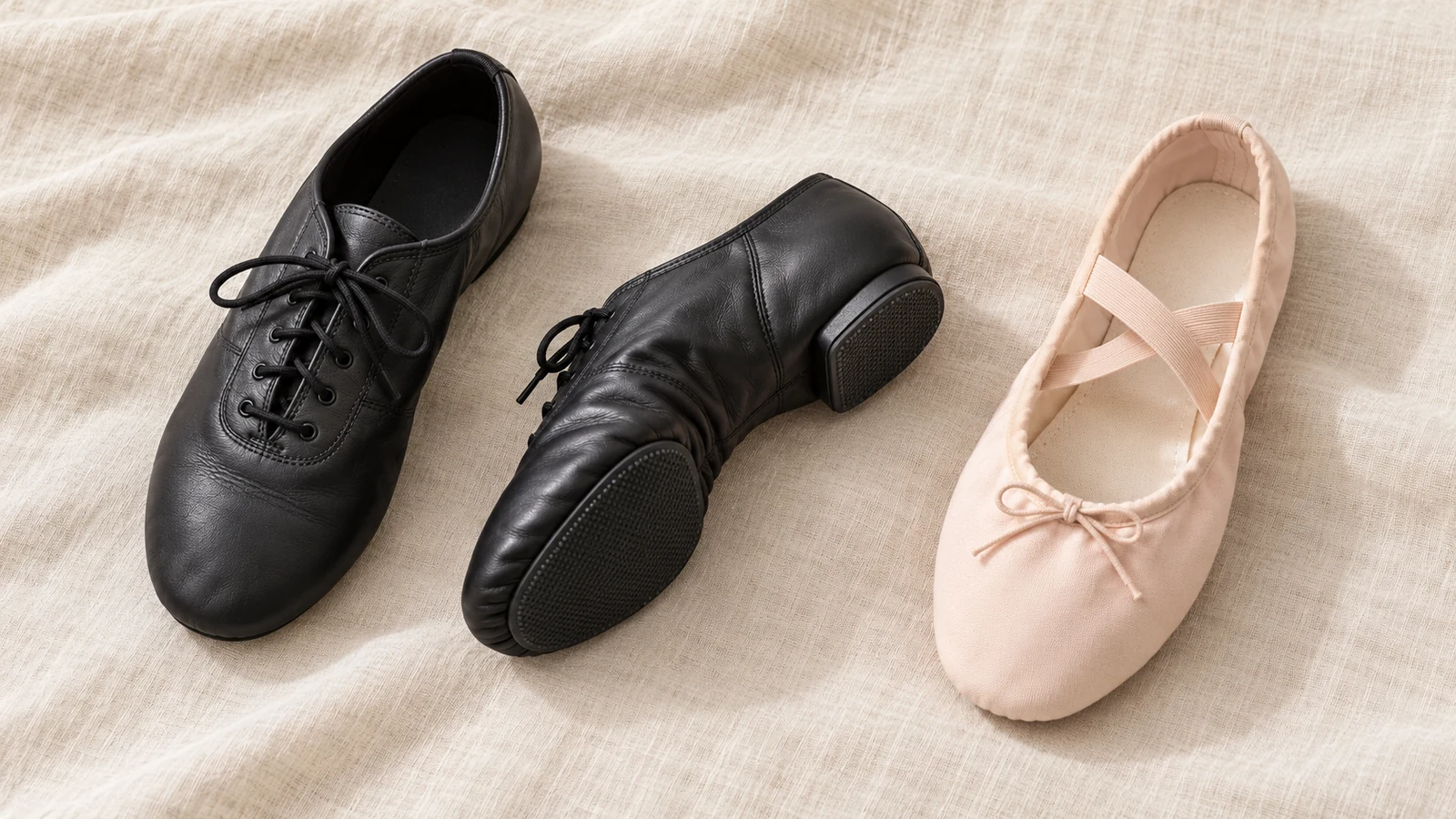
Lace-Up Jazz Oxfords

The traditional jazz shoe: a low-heeled leather shoe with laces, a split rubber sole, and a round toe. These are the most common jazz shoes used for ISTD modern theatre examinations and jazz classes. They provide support for the ankle and a clean look for theatrical performance.

Slip-On Jazz Shoes

A slip-on style without laces, typically made from leather or microfibre with an elasticated panel for a secure fit. Quicker to put on and remove, popular for recreational jazz classes.

Jazz Sneakers

A hybrid between a jazz shoe and a street sneaker: more cushioning, a flat or very low heel, and a design that suits street jazz, hip hop fusion, and commercial dance styles. Jazz sneakers are common in non-syllabus jazz classes and contemporary commercial dance training.

Split-Sole Jazz Shoes

Jazz shoes with a split sole (rubber pads at the ball and heel, with a gap in the middle) that allows the arch to flex fully during pointing and floor work. Preferred by dancers who need maximum foot articulation during jazz technique.

Who Needs Jazz Shoes?

Jazz shoes are required for:

  • Students taking ISTD modern theatre or jazz examinations — the specific shoe style is part of the exam uniform
  • Students in jazz dance classes at most dance schools
  • Musical theatre students performing tap-free numbers

Students doing exclusively classical ballet, contemporary (usually bare feet), or tap dance (which uses tap shoes) do not need jazz shoes.

How to Choose Jazz Shoes

Check the syllabus requirement first. If your child is taking ISTD modern examinations, there may be a specified shoe style and color (usually black). Ask your teacher before buying.

Fit: Jazz shoes should fit snugly with no slipping at the heel and no bunching of material at the toes. Unlike street shoes, there should be no “growing room” — a shoe that is too big will slip during turns.

Material: Leather jazz shoes last longer and shape to the foot over time. Synthetic microfibre shoes are lighter and more affordable but may not be as durable for intensive use.

Jazz Shoes vs Character Shoes

Character shoes are a different type of dance shoe — typically a closed-toe, strapped shoe with a 1.5–2 inch heel, used for character dance in ballet (flamenco variations, Spanish, Hungarian etc.) and for RAD character examinations. Jazz shoes and character shoes are not interchangeable. See our guide: What Are Character Shoes?

Frequently Asked Questions

Can my child use ballet shoes for jazz class?

No — ballet shoes are not appropriate for jazz classes. They do not provide the grip, heel structure, or sole design that jazz technique requires, and their use in jazz class may be corrected by the teacher. The correct footwear for jazz is always jazz shoes or jazz sneakers as specified by the school.

What color jazz shoes do children usually wear?

Black is the most common color for jazz shoes in examined syllabi (ISTD, BATD). Tan/caramel jazz shoes are used for some performance contexts. Your teacher or school will specify the required color.

How long do jazz shoes last?

A quality leather jazz shoe worn for one to two classes per week should last 12–24 months in a child who is not growing rapidly. Intensive use or a fast-growing student will require more frequent replacement. Check the soles periodically — worn rubber soles reduce grip and should be replaced.

Posted on

How to Improve Flexibility for Dancing: A Complete Guide

How to Improve Flexibility for Dancing: A Complete Guide

Why Flexibility Matters for Dancers

Flexibility is one of the physical foundations of dance. Whether your child studies ballet, contemporary, or jazz, a supple, well-conditioned body allows for safer movement, greater range of expression, and reduced injury risk. The good news: flexibility can be improved at any age with consistent, correct practice.

This guide covers the most effective methods recommended by dance physiotherapists and experienced teachers — safe for children, teenagers, and adult beginners alike.

The Difference Between Flexibility and Hypermobility

It is important to distinguish between flexibility (earned range of motion achieved through regular stretching and strengthening) and hypermobility (a joint laxity that some people are born with). Hypermobile dancers need strength work more than stretching — pushing already loose joints further increases injury risk. If your child’s joints click, hyperextend easily, or if they have been told they are “double-jointed,” consult a physiotherapist before starting an intensive flexibility program.

The Golden Rules of Stretching for Dancers

  • Never stretch cold — always warm up with 5–10 minutes of light movement (jogging on the spot, jumping jacks, body rolls) before any deep stretch
  • Hold, don’t bounce — static stretches held for 30–60 seconds are safer and more effective than bouncing (ballistic) stretches for developing long-term range
  • Breathe throughout — tension and held breath prevent muscles from releasing; exhale as you deepen a stretch
  • Pain is a stop signal — a stretching sensation is normal; sharp, stabbing, or joint pain is not and means stop immediately
  • Stretch after class, not before — the optimal time for deep flexibility work is after a full class when the body is thoroughly warm

Key Areas to Stretch for Ballet

Hamstrings

Tight hamstrings limit arabesque height, grand battement, and developé. Effective stretches: standing forward fold, seated pike stretch, and lying hamstring stretch with a resistance band. Hold each for 45–60 seconds per leg.

Hip Flexors

Tight hip flexors restrict arabesque, attitude, and high leg extensions to the back. The kneeling lunge stretch (low lunge) is one of the most effective: kneel on one knee, shift the hips forward gently, keeping the torso upright. Hold 45 seconds each side.

Turnout (External Hip Rotation)

Ballet turnout comes from the hip joint, not the knee or ankle. The butterfly stretch (sitting with soles of the feet together) and the figure-four stretch both target the external rotators. Strengthening these muscles is equally important — strong rotators provide sustainable turnout rather than forced positions that injure the knees.

Back

A supple, supported back is essential for port de bras and cambrés. The cobra stretch (lying on the stomach, pressing up through the hands to extend the spine) and the cat-cow exercise (on all fours, alternately arching and rounding the back) are safe and effective. Back flexibility work should always be paired with core strengthening.

Feet and Ankles

A well-pointed foot requires flexibility through the instep and toes. The tendu exercise builds this over time. Specific stretches: gently pressing the top of the pointed foot toward the floor, and theraband resistance work through the full range of point and flex.

Strengthening: The Essential Partner to Stretching

Flexibility without strength creates unstable joints and increases injury risk. For every stretching session, include complementary strengthening work:

  • Core — plank holds, Pilates hundred, bicycle crunches
  • Glutes and hip rotators — clamshells, side-lying leg lifts, resistance band work
  • Ankle and foot — relevés, single-leg balance, theraband exercises

How Often Should You Stretch?

For measurable progress: daily stretching of 15–20 minutes produces results faster than three sessions per week. Consistency over months — not days — is what creates lasting change. Most dance physiotherapists recommend a 3–6 month program before expecting significant improvement in a stiff area.

What to Wear for Stretching Practice

Wear fitted, stretchy clothing that does not restrict movement. A fitted leotard with tights or warm-up trousers lets you and your teacher see alignment clearly. Leg warmers keep muscles warm during a cool-down stretch.

Frequently Asked Questions

At what age can children start serious flexibility training?

Children are naturally more flexible than adults and can begin gentle stretching from the earliest classes. However, intensive flexibility training — including oversplits and deep backbends — should wait until a child is physically mature enough and always be supervised by a qualified teacher. The RAD‘s syllabus introduces stretching progressively through the grades.

How long does it take to get the splits?

This varies enormously by individual anatomy, current flexibility, and training frequency. A student who stretches daily and is already moderately flexible might achieve a flat split in 3–6 months. A naturally tight student may take a year or more. Neither timeline is wrong — consistency matters more than speed.

Is yoga good for dancers’ flexibility?

Yes. Yoga develops both flexibility and body awareness, and many professional dancers use it as a supplement to their dance training. Yin yoga (long-held passive stretches) is particularly effective for developing range. Pilates is equally beneficial for strengthening the core and stabilising flexible joints.

Can stretching before class cause injury?

Cold static stretching before class can temporarily reduce muscle power and increase injury risk. The current guidance from sports medicine and dance medicine is to use dynamic movement (leg swings, body rolls, light jumping) to warm up before class, and save deep static stretching for the end of the session when the body is fully warm.

Posted on

What Is a Sickled Foot in Ballet and How to Correct It

What Is a Sickled Foot in Ballet and How to Correct It

What Does “Sickled Foot” Mean in Ballet?

A sickled foot (sometimes called “sickling”) occurs when a dancer’s foot curves inward so that the toes point toward the body’s midline rather than directly forward or away from it. Instead of the clean, aligned arc from heel to toe that good ballet technique requires, the ankle rolls inward and the foot appears to curve like a sickle blade — hence the name.

Sickling is one of the most commonly corrected faults in ballet class, and teachers address it at every level from Primary through to professional training. Understanding what causes it and how to correct it helps students and parents appreciate why teachers mention it so frequently.

What a Well-Aligned Foot Looks Like

In a correctly pointed foot, the line runs from the lower leg, through the ankle, through the instep, and out through the toes in a continuous, smooth arc. The ankle does not roll in (sickle) or out (wing, the opposite fault). Viewed from in front or behind, the foot appears to be a direct extension of the leg.

In a tendu, relevé, or any pointed position, this clean line is one of the fundamental aesthetic requirements of classical ballet.

What Causes Sickling?

Sickling has several causes:

  • Muscle imbalance — weakness in the peroneals (the muscles that run along the outside of the lower leg) allows the ankle to roll inward. Strengthening these muscles is the primary correction.
  • Habitual foot position — some students develop a sickle through repeated poor placement that has not been corrected early. Muscle memory can reinforce incorrect patterns.
  • Compensating for tight ankles — when a dancer cannot achieve a fully pointed foot through ankle and instep flexibility, they sometimes sickle to create the illusion of a more pointed toe. This is why foot flexibility work and sickling correction go hand in hand.
  • Anatomy — the shape of the ankle joint and the foot’s natural alignment vary between individuals, which means some students are more prone to sickling than others.

Why Sickling Is a Problem

Beyond aesthetics, sickling has practical and safety implications:

  • It weakens the ankle’s structural support, increasing the risk of ankle sprains
  • In pointe work, a sickled ankle is at significantly higher risk of rolling over — one of the most serious injuries in ballet
  • It disrupts the line of the leg, affecting the visual quality of every position and step
  • It places uneven stress on the knee and hip over time

How to Correct a Sickled Foot

Awareness First

Many students sickle without realising it. A full-length mirror at home allows a student to observe their own foot during barre exercises. When practicing tendu, relevé, or any pointed position, actively check: is the line clean? Is the ankle rolling inward?

Theraband Exercises

Using a resistance theraband to work through the full range of the foot — point, flex, and side-to-side — strengthens the peroneals and trains the correct ankle alignment. A dance physiotherapist can demonstrate the specific exercises most effective for sickling correction.

Towel Scrunches and Intrinsic Foot Work

See the foot strengthening exercises in our ballet foot care guide — these build the small muscles of the foot that support correct alignment.

Teacher Corrections

In class, a teacher correcting sickling is doing important safety work. Students should take these corrections seriously and incorporate them into their home practice.

Sickling vs Winging: The Opposite Fault

Winging is the opposite of sickling — the foot curves outward, with the toes angling away from the midline. Winging is sometimes considered more aesthetically desirable in classical ballet (a slightly winged foot can create a beautiful line in certain positions), but extreme winging, like extreme sickling, creates instability. A correctly aligned foot sits between the two extremes.

Frequently Asked Questions

Can sickling be permanently corrected?

Yes, in most cases. With consistent targeted exercises and mindful practice, the muscle patterns that cause sickling can be retrained. The earlier the correction begins, the faster the improvement. Adult beginners can also correct sickling, though it may take longer to override ingrained habits.

Is sickling always the student’s fault?

Not always. Some students have ankle structures that make neutral alignment more challenging. In these cases, the teacher and student work together to find the most aligned position within the student’s anatomical constraints, rather than forcing an ideal that creates other compensations.

Should a student with persistent sickling wear pointe shoes?

A sickled foot is one of the assessments teachers consider before recommending pointe shoe fitting. Persistent sickling without improvement is typically a reason to delay pointe work until the ankle alignment is more stable. This decision is made by the teacher, not the student or parent.

Posted on

What Is an Arabesque in Ballet? Positions, Technique and Tips

What Is an Arabesque in Ballet? Positions, Technique and Tips

The Arabesque: Ballet’s Most Iconic Position

The arabesque is one of the most recognisable images in classical ballet — the dancer balancing on one leg with the other extended behind them in a long, elegant line. It appears in every level of ballet training from Pre-Primary through to the most advanced professional repertoire, and it is one of the first positions that people associate with classical dance.

Understanding what an arabesque is, how it is performed, and what its variations are helps students and parents appreciate what teachers are working toward when they call for this position.

The Basic Definition

An arabesque (from French, meaning “in Arabic fashion”) is a position in which the dancer stands on one leg — either flat, in demi-pointe (on the ball of the foot), or en pointe — and extends the working leg behind them at a specific height and angle. The supporting leg is straight; the working leg is fully extended with a pointed foot. The arms are held in a defined position, and the body maintains an upright or slightly forward incline depending on the arabesque number.

The Four Standard Arabesques

In the Vaganova (Russian) school and most classical systems, there are four numbered arabesque positions, distinguished by the placement of the arms:

First Arabesque

The downstage arm is stretched forward, the upstage arm is extended to the side. Both arms are at the same height. The body faces slightly forward. This is the most commonly seen arabesque in teaching and is the first one students learn.

Second Arabesque

The upstage arm stretches forward; the downstage arm extends to the side. This is the mirror arrangement of the first, and creates a different visual line relative to the audience.

Third Arabesque

Both arms reach forward, one in front of the other, with the downstage arm slightly higher. Less commonly seen in teaching than first and second, but appears in repertoire.

Fourth Arabesque

Both arms reach forward at the same height but in opposition — this creates the most complex arm line of the four. Associated particularly with the Cecchetti method.

Different ballet schools (RAD, Cecchetti, Vaganova, French) define the four arabesques slightly differently. Students follow the specific system taught by their school.

What Makes a Good Arabesque

A well-executed arabesque requires:

  • A stable, straight supporting leg — any bend in the knee creates a visual break in the line and reduces balance
  • Maximum length in the back leg — the heel pushes away from the body, the knee is straight, and the foot is fully pointed
  • Square hips — ideally both hips face forward; as the working leg rises higher, some rotation is inevitable, but excessive hip opening is corrected
  • A lifted back — the spine should be long and supported, not collapsing into the lower back; the shoulder blades draw down and together
  • Length through the arms — arms are carried with energy to the fingertips, not dropped or loose
  • A focused gaze — eyes look forward or slightly upward; the chin is not dropped

Arabesque in the Classical Repertoire

The arabesque appears throughout the major ballets. Some of the most famous include the arabesque promenade in The Sleeping Beauty (Princess Aurora’s Rose Adagio, where she holds an arabesque balance while her hand is passed between four princes), and the long arabesque penché (leaning forward while the back leg rises) seen in Giselle and Swan Lake.

Arabesque Height: What Is Realistic?

Ballet teachers and audiences sometimes fixate on the height of the arabesque, but technique and line matter more than height alone. A 45-degree arabesque with perfect alignment is more beautiful and more correct than a 90-degree arabesque with a collapsed back, rotated hips, and bent knee. Height develops naturally as flexibility and strength improve over years of training.

Frequently Asked Questions

At what level do students learn arabesques?

In the RAD syllabus, arabesque first appears formally at Grade 1. In Pre-Primary and Primary, preparatory positions that develop the same body awareness are introduced. By Grade 3–4, students are working on maintaining arabesques in combinations and across the floor.

How is arabesque different from attitude?

In an attitude, the working leg is raised behind (or in front) with the knee bent at approximately 90 degrees. In an arabesque, the working leg is fully straight. Both positions extend the leg behind the body; the distinction is whether the knee is bent or straight.

Why does my child’s arabesque look low compared to others?

Arabesque height depends on hamstring flexibility, hip flexor flexibility, core strength, and back mobility — all of which develop at different rates. Comparing children’s arabesques is rarely useful; consistent training and targeted flexibility work produce steady improvement over time.

Posted on

Ethan Stiefel: Dancer, Director and Ballet’s Modern Icon

Ethan Stiefel: Dancer, Director and Ballet’s Modern Icon

Who Is Ethan Stiefel?

Ethan Stiefel (born 13 April 1973, Tyrone, Pennsylvania) is one of the most celebrated American male ballet dancers of his generation — and one of the few to have achieved mainstream cultural recognition through both his performing career and his appearance in the 2000 film Center Stage. He served as a principal dancer with American Ballet Theatre and later as Artistic Director of the Royal New Zealand Ballet, shaping ballet on two continents.

Early Life and Training

Stiefel began dancing at age seven and showed exceptional talent from his earliest training. He studied at the University of North Carolina School of the Arts and later at the School of American Ballet, the official school of New York City Ballet. He joined New York City Ballet in 1992 as a corps de ballet dancer and was promoted rapidly through the ranks, becoming a principal dancer — the company’s highest rank — within a few years.

Career at American Ballet Theatre

In 1997, Stiefel joined American Ballet Theatre as a principal dancer — a move that proved defining for his career. At ABT he danced the full classical repertoire: Prince Siegfried in Swan Lake, Prince Désiré in The Sleeping Beauty, Romeo in Romeo and Juliet, and Albrecht in Giselle, among many others. He also performed extensively in contemporary works by choreographers including Twyla Tharp and Alexei Ratmansky.

His technique was distinguished by exceptional clarity, powerful elevation, and an ability to make technically demanding passages appear effortless. He was widely regarded as one of the finest classical male dancers of his era, and his partnership with Julie Kent at ABT was considered one of the most compelling of the period.

Center Stage: Ballet Reaches a Wider Audience

In 2000, Stiefel played the role of Cooper Nielsen in Columbia Pictures’ Center Stage — a drama set at a fictional American Ballet Academy. The film followed a group of young dancers through their final year of training and included authentic performances by professional ballet dancers. Stiefel’s charismatic presence and genuine dancing ability gave the film a credibility it might otherwise have lacked, and it introduced a generation of young people to ballet who might never have attended a performance. Center Stage remains one of the most widely-seen ballet films ever made.

A sequel, Center Stage: Turn It Up (2008), also featured Stiefel.

Artistic Director: Royal New Zealand Ballet

After retiring from full-time performing, Stiefel was appointed Artistic Director of the Royal New Zealand Ballet in 2011 — a position he held until 2014. During his tenure he expanded the company’s repertoire, brought international guest artists to New Zealand, and significantly raised the company’s profile internationally. He was succeeded by Francesco Ventriglia.

Legacy and Influence

Ethan Stiefel’s career represents a model for the modern male dancer: technically brilliant, artistically versatile, willing to embrace both classical and contemporary work, and able to communicate beyond the ballet world to mainstream audiences. His work with ABT, his film presence, and his leadership of a national company demonstrate the range of paths open to exceptional male ballet artists.

For young male students who sometimes feel that ballet is not “for them,” figures like Stiefel — alongside Baryshnikov, Nureyev, and Carlos Acosta — provide powerful examples of the career that disciplined training can produce.

Frequently Asked Questions

Is Ethan Stiefel still dancing?

Stiefel has retired from full-time performing. He continues to be involved in dance through teaching, coaching, and occasional guest appearances. His focus shifted to arts leadership and education after his tenure at the Royal New Zealand Ballet.

What makes Center Stage worth watching for ballet students?

Beyond its drama, Center Stage shows authentic professional ballet technique — the barre work, rehearsals, and performance sequences are genuinely performed by trained dancers, not simulated. It also portrays realistic aspects of a ballet dancer’s life: the physical demands, the competition for roles, and the sacrifices the career requires.

Did Ethan Stiefel train with the Royal Ballet School?

No — Stiefel trained in the United States, primarily at the School of American Ballet, which follows the Balanchine tradition. He is a product of the American classical ballet system rather than the British or Russian schools.

Posted on

Contemporary Dance vs Modern Dance: What’s the Difference?

Contemporary Dance vs Modern Dance: What’s the Difference?

Two Terms, Two Very Different Things

The terms “contemporary dance” and “modern dance” are often used interchangeably by parents and even by some dance schools — but in the world of dance, they refer to distinct traditions with different histories, aesthetics, and techniques. Understanding the difference helps you make sense of what your child is actually learning.

What Is Modern Dance?

Modern dance is a specific historical movement that emerged in the late nineteenth and early twentieth centuries as a deliberate rejection of the rigid conventions of classical ballet. Pioneered by American and European choreographers including Isadora Duncan, Martha Graham, Doris Humphrey, José Limón, and Laban Rudolf von Laban, modern dance rebelled against the turnout, pointe shoes, and stylised positions of classical ballet in favour of natural movement, gravity, the floor, and emotional expression.

By the mid-twentieth century, modern dance had developed its own codified techniques — most notably the Graham technique (centered on contraction and release of the torso) and the Humphrey-Limón technique (built around fall, recovery, and suspension). These are still taught today as distinct syllabi, just as RAD or Cecchetti are syllabi for classical ballet.

In the UK and many other countries, “modern” at a dance school often refers specifically to a theatrical modern or stage dance curriculum — often examined through ISTD or RAD modern theatre syllabi — which is a separate stream from classical ballet and includes elements of jazz and theatre dance.

What Is Contemporary Dance?

Contemporary dance is not a specific technique but a broader, ongoing practice. It emerged from modern dance in the 1950s and 60s — particularly through the Judson Dance Theater in New York, which stripped dance down to its most basic elements — and has continued to evolve ever since. Contemporary dance draws on ballet, modern, jazz, release technique, somatic practices (such as Body-Mind Centering), improvisation, and physical theatre.

There is no single “contemporary technique” the way there is a Graham technique or a Cecchetti technique. Contemporary training typically involves exposure to multiple movement systems. The emphasis is on individual expression, conceptual thinking, collaboration, and physical versatility rather than mastery of a fixed style.

Professional contemporary dance companies — such as Rambert, DV8 Physical Theatre, and Akram Khan Company — each have highly distinctive artistic vocabularies. A dancer trained in contemporary dance needs to be adaptable, articulate about movement, and physically fluid across a wide range of styles.

Key Differences at a Glance

Aspect Modern Dance Contemporary Dance
Origin Late 19th – early 20th century Mid-20th century, ongoing
Structure Specific codified techniques (Graham, Limón) No single technique; pluralistic
Relationship to ballet A reaction against it Often incorporates it alongside other forms
Floor work Central to most modern techniques Varies; often extensive
Shoes Bare feet, jazz shoes, or foot thongs Bare feet most common; varies
Taught at exam level Yes — ISTD, RAD modern theatre syllabi Usually non-syllabus or higher-level only

What Do Dance Schools Actually Teach?

At a typical RAD or ISTD-affiliated dance school in the UK:

  • Ballet follows the RAD or ISTD classical syllabus
  • Modern typically refers to ISTD modern theatre or a similar syllabus — it has a specific syllabus with grades and examinations
  • Contemporary may be offered as a separate class, usually from secondary school age, and draws on release technique, improvisation, and contemporary choreography

If you are unsure which style your child is enrolled in, ask the school which syllabus (if any) applies and whether there are examinations.

Frequently Asked Questions

Is contemporary dance harder than ballet?

They are different rather than harder or easier. Ballet has a highly codified technique with precise requirements for every position and movement. Contemporary dance requires physical versatility and the ability to work across multiple movement systems. Both demand years of training and significant physical conditioning.

Can a ballet student also study contemporary?

Absolutely — and it is encouraged. Classical ballet training provides excellent physical foundations (strength, flexibility, body awareness) that support contemporary dance. Many professional contemporary dancers trained in classical ballet first. The two are highly complementary.

What should my child wear for contemporary dance?

Contemporary dance is typically done in bare feet. Fitted dance clothing — a leotard, shorts, or stretchy dance trousers — allows the teacher to see alignment. Unlike classical ballet, contemporary does not usually require a specific uniform, though each school may have preferences. See our guide: Contemporary Dance Outfits.